
ES ES-OVNI RSC-1965
·
Item
·
2003
Part of Non-Identified Video Observatory (OVNI)
Italy
125 Archival description results for Italy
125 results directly related
Exclude narrower terms
ES ES-OVNI RSC-4190
·
Item
·
2016
Part of Non-Identified Video Observatory (OVNI)
Interview with Marcello Tarì.
ES OVNI RSC-1364
·
Item
·
1996
Part of Non-Identified Video Observatory (OVNI)
Fiction Cinema-Verite style. It is one of the 9 episodes of "Stories of the Rainbow", collective international project curated by Een Rotterdam study. The occultist Aleister guide a scientific expedition on an island infested with minute and trivial spirits. Shot in Super 8.
ES ES-OVNI RSC-4336
·
Item
·
2023
Part of Non-Identified Video Observatory (OVNI)
A video essay by Alessandro Quaranta and Toni Cots, in collaboration with CRA’P – Creation Practices and Artistic Research. In Light / Vibration a concern emerges for those places, even anonymous, corporeal and geographical, that are responsible for momentary illuminations and visions of the soul. The research has focused on the conflictivity existing in the interpretation of reality, along with a critique of modernity, using the duplicity of opposites (light/darkness, place/space, sacred/divine), identifying them as a model to explore different authorial videos, interviews and various documentaries. Authors cited: Toni Serra / Abu-Ali, Toni Cots, Fernand Deligny, Esther Freixa i Ràfols, Gian Antonio Gilli, Ariel Jimenez, Alessandro Quaranta, Jesus Rafael Soto, Laurel Swenson, Renaud Victor, Peter Watkins. This video essay is a non-profit research project for educational purposes.
ES ES-OVNI RSC-3676
·
Item
·
2008
Part of Non-Identified Video Observatory (OVNI)
translate
ES ES-OVNI RSC-4311
·
Item
·
2006
Part of Non-Identified Video Observatory (OVNI)
The neutral surface of the screen is continuously traversed by luminous interferences. The surface, defined by the screen, is traversed by a beam of light in multiple directions, revealing bodies of different nature and identity. Light, as a technical resource, names the object and, in its incessant movement, establishes a play of correspondences. Light is the eye that forms a singularity from the whole. Light is the language that isolates from the indistinct noise of sounds.
Untitled
ES ES-OVNI RSC-4300
·
Item
·
2021
Part of Non-Identified Video Observatory (OVNI)
“Lui ed io” tells the thoughts of a woman as a wife and a mother, and how she lived through these roles between obligation and choice. The woman, filmed through the footage taken by her husband, militant and always far from home, is revealed as opposed to her husband’s world. A reinterpretation of women’s world as a politic act, aiming to tell that love is an act of acceptance of differences, and also that personal memories are part of collective history.
ES ES-OVNI RSC-1623
·
Item
·
2004
Part of Non-Identified Video Observatory (OVNI)
Otranto, Torre del Serpente, the easternmost part of Italy, the point where, lest we forget, East and West once touched. Today, the memory of that link seems to re-emerge as a consequence of all the illegal immigrants that disembark on its beaches, as their clothes, shoes and personal effects found along the coast remind us. To those among them that did not make it, we dedicate the canto of the polyphonic Albanian chorus of Lapardha that, on August 5, 2002, at dawn, sang one of its passage for the victims of the 1997 “accident”, in which dozens of Albanians died aboard a boat sunk by the Italian navy.
Untitled
ES ES-OVNI CTX-S011-SS006-0098
·
Item
·
1938
Part of Non-Identified Video Observatory (OVNI)
For the first time, the Luce Institute presents one of its best-known documentaries, to show people today the deeds and images of the old times, in original version, restored, without any changes to the editing.
ES ES-OVNI CTX-S011-SS004-0015
·
Item
·
1971
Part of Non-Identified Video Observatory (OVNI)
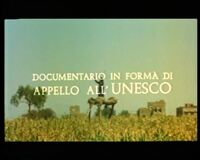
On Sunday October 18, 1970, the last day filming “Flower of the Arabian Nights” on location in Sanaa, the capital of Yemen, Pasolini decides to use some leftover rolls of film to make a documentary about the city and thus persuade Unesco to intervene to protect the beauty of this world heritage. ”With every passing day, one part of the Sanaa walls falls to pieces... One of my dreams is to save Sanaa and other cities – their historic centres. I will strive for my dream and endeavour for Unesco to intervene”, says Pasolini.
Untitled