Images of 'Italian Popular Bench' have been realized in approximately 6 years, since autumn of 2000. They frame the same park bench in Finanze Square, in Rome. Since the beginning of the new millennium this bench has given rest and shelter to hundred of persons, becoming a witness of the passage and the meeting of people of all etnies.
Italy
125 Archival description results for Italy
Pier Paolo Pasolini is one of cinema's greatest figures. The influence he continues to exert to this day, one of the of the many contradictions surrounding his life, has not yet been fully recognised. Responsible for a challenging, hard-to-classify body of film and literary work, and an equally explosive personality, Pasolini talks calmly, splendid as ever in front of the camera (despite all the uproar and expectations around the shooting of “Salo, or the 120 Days of Sodom” at the time), as he concisely explains his views on cinema and life. Bertolucci thus achieves a true portrait, allowing Pasolini has to talk about his own work and ideas with the filming of Salo as a starting point, and weaving in an interview by journalist and documentary maker Gideon Bachmann with photos by Deborah Imogen Beer also taken at the set of what would be, due to his early, violent death in 1975, his last film.
Untitled“Do you maintain that the bourgeoisie is triumphing?.” “Yes, it is. And the neo-capitalist, consumer society is the true bourgeois revolution.” “I have banished the word ‘hope’ from my vocabulary; I continue to fight for concrete truths at each moment.”
Untitled“Fascism was just a bunch of criminals in power, but it managed to deeply transform Italy. Nowadays the opposite is true, and the power of today’s democratic regime is managing to achieve the acculturation and standardization that fascism was unable to complete. The power of the consumer society that destroys other particular realities and impoverishes the diversity of human beings.”
Untitledtranslate
3 Mostra de Vídeo Independent de Barcelona 1996.
UntitledA film director suddenly dies during the preparatory stages of a documentary titled “Prostor v tej galaksiji” (A Place in This Galaxy). The film should have closely explored the ever tangled relations of personal memory and images – photographs, filmed sequences – through a reflection on their alleged documentary objectivity, doubting the very character of the testimonies whereupon one bases the sharing of a plural, collective memory. A woman-friend of the deceased film director – she herself a documentarist – decides to finish the incomplete project, starting out from the materials found in the flat where he lived: a bunch of pages of a fragmentary, incomplete screen-play; a heap of untidy, hardly readable notes; filmed sequences and photographs emerging from wardrobes and drawers; just a few, already shot, inscrutable and apparently disconnected scenes; literary quotations; personal recollections; loose thoughts and queries striking one during the idle time of one's waits.
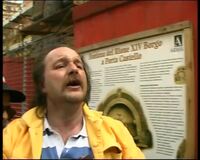
An account of the growing tension in a city during the year of its transformation for the Jubilee. A documentary about the hysteria of Rome as it prepares for the invasion. It is set out as a chronicle of the nine months preceding the start of the Holy Year, told through ten characters and their ways of dealing with everyday obstacles. Rome spent more on “beautifying” Rome in the lead up to the Jubilee than it had in the ten preceding years, and 55 million pilgrims and tourists were expected to visit the city in 2000.
Essay-film experiments, a third dimension of Situationist texts. Ralph Rummey text illustrated with a sequence of 12 shots from the film "Spione" by Fritz Lang in 4 different variants.