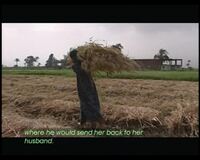
Janata Bennuna is from Morocco; Hanan Al Shaykh is from Lebanon; and Nawal Al Saadawi is from Egypt. All three are authors of the Arab word, committed intellectuals who shed light on the complex social reality of the Arab world through their books. In their hands, literature becomes a weapon through which to draw attention to and denounce situations that they oppose. The three women, from a generation heavily influenced by Pan-Arabism, initially studied against the wishes of their families, but ended up gaining their support. In A Woman's Word, these three very different writers who nonetheless share a common ground talk about their lives and their work. By learning about them, we also gain an insight into the Arab world, which is much more complex than the Manichean and mostly malicious information on the subject that predominates in our own society today. They too are Arabs, women, who refuse the victim mentality, and demand their rights through their work and their commitment.
UntitledIslam
14 Archival description results for Islam
Al Barzaj [Between the worlds] is a poem about the halfway world, between the visible and the invisible, sleep and wakefulness... An inner journey through underground streets, secret gardens.
UntitledBoujad is a personal and anguishing look at issues of separaton, independence and return. As director Hakim Belabbes chronicles his journey from his home in Chicago to visit his family in his hometown of Boujad in Morocco, his exploration of family relationships is self-conscious and at times painfully honest. We witness his most private moments with his family. Belabbes' film intimately explores the domestic spaces and religious rituals of intra-family relationships, especially when compounded by one member's break with traditional values.
UntitledA strange Sheikh in a barely-glimpsed place: "Destiny is as wide as a hand and four fingers, the width of a grave. The man who owns 40 buses, what does he really have? The man who owns 4 houses, poor fellow! What does he have? A grave!...?" Video Serie: El Hamdulillah Tapes * Pirate Utopias & European Renegadoes.
UntitledThe urban and social structure of neighbourhoods in the medina is one of vast intricacy and complexity, being organized around a series of vital establishments for the everyday life of their inhabitants, such as the hammam or public baths, the bakery, schools and the foundouk, or caravanserai. Communal bakeries provide the heating for the public baths or hammam, fully active establishments that are very important for the cohesion of the city's social fabric. Foundouks are establishments where visiting merchants traditionally stayed and stored their products overnight. Most have now lost their original function and are adapted for other uses, such as dwellings or workshops.
In a time that is becoming difficult for bees (as for us) In a year of severe drought, in a country that is already often arid, taking the path of bees has been to make a journey through moors and mountains, but also through states of mind, obstacles and encounters .. until reach their generous garden. Video made for the BEEHAVE exhibition, Joan Miró Foundation 02/16/2018 - 05/21/2018. Available online until December 27th 2020.
An initiatic journey Videos from an exhibition at the Centre de Cultura Comtemporània de Barcelona from March 26 to May 30, 2002 (a project by Albert Garcia-Espuche and Toni Serra). Into the innermost parts of the city of Fes.Using audiovisual recordings that illustrate some of the different anthropologic, sociologic, urbanistic and religious aspects that make up the fabric of the city. A journey that requires both objectivity (in the working method) and subjectivity (for the experience of the journey and immersion in another culture).
A journey of initiation into a city and a its culture. The set of projections (10 screens) aimed to create a journey in the complex sense of the term: using audiovisual segments to illustrate aspects of the anthropological, sociological, urban and religious tissues of the city. A journey claiming both: a certain objectivity (in the working method), and the subjectivity (of the travel experience and approach to another culture). Moreover, the projections do not meet the criteria of a film with a beginning and an end, but rather the creation of a landscape, so the viewer choosed the time he/she wished to dedicated to each fragment. This made it possible to enjoy a deeper level of inquiry to specific fragments (artisans, rituals interviews, etc.). Consequently, the result of each visit to the exhibition gave an unique combinatorial fragments, since the total length of the projections would be about 6 hours. VideoInstallation 10 screens total lenght: 6h 40' Toni Serra , Albert García Espuche CCCB Centre de Cultura Contemporània de Barcelona 2002
UntitledAnonymous guide. Fes el Bali, the old medina of Fez founded in 809 by Idris II, is still completely contained within city walls. The gates (Bab Bou Jeloud, Bab Fteuh, Bab Er Rsif, Bab Guissa...) therefore retain all their social and symbolic value, associated with the different activities of the city and its inhabitants.
Fez is the Moroccan city with the liveliest tradition of artisans. Far from being "just a job", the activity of the artisan reflects a whole conception of the world and a way of experiencing time and giving it meaning. This native wisdom is passed down from parents to children, from the maalem, the master, to the apprentice.