
collection Petites Planètes. ‘Jihad’ is a fundamental Arab concept. In these times of conflict and violence, we only hear the mass media version – the extreme meaning of the term, which has strayed from its original sense – while its deeper meaning is ignored. Jihad can be translated as effort, commitment, and struggle in the broad sense. It is a concept and an experience with two different levels, one subordinate to the other. On one hand there is the ‘small jihad’ which has to do with effort, with the communal struggle to attain a society that is fairer and more aware of the mystery of reality (Al-Haqq) and of life (Al Hayy), which are two of the names of Allah. And the other is the ‘great jihad’, which is considered more important, and which determines whether the success, failure, or digression of the small jihad. This great struggle is the inner quest, the effort to cleanse everything inside us that distances mankind from the real... everything that favours a world made up of separate, selfish entities, a world that is closed, appropriable, and doomed to conflict. One of the most beautiful and profoundly meaningful practices of the great jihad is the ritual ceremony of ‘dhikr’ (zikr), an Arabic word that means memory... and in this context refers specifically to the memory of Allah... a personal reencounter - within a collective ceremony - with the mystery of the Real... in other words, with that which is cannot be defined, represented, or appropriated... that which is beyond physical or rational measure. According to this tradition, only one organ is capable of accommodating such an immensity: the human heart. Sufism struggles to remain within the heart of Islam. And in suffering Chechnya, Sufism is the most widespread form of Islam. Vincent Moon and Bulat Khalylov recorded a beautiful, immersive form of the experience of this dhikr ceremony.
UntitledIslam
54 Archival description results for Islam
54 results directly related
Exclude narrower terms
ES ES-OVNI CTX-S017-SS001-0003
·
Item
·
2012
Part of Non-Identified Video Observatory (OVNI)
ES ES-OVNI RSC-4140
·
Item
·
2013
Part of Non-Identified Video Observatory (OVNI)
A man (played by the filmmaker Nacer Khemir) returns home to Tunis to bury his mother. After the burial, his father gives him an "amana" to be handed to a certain Sheikh named Muhyiddin. Taken by his father's request, the man immediately sets out on an epic journey to find the long lost Sheikh and deliver the "amana." Throughout the trip, he is guided by a mysterious spiritual master and the many friends of the Sheikh he encounters along the way. As the adventure unfolds, we discover the rich life of this Sheikh and his uncompromising love for humanity. For under his teachings, different beliefs, faiths, and ways of life can only converge and become one The more we learn about Sheikh Muhyiddin, the more we understand why he is venerated across cultures and continents. Looking for Muhyiddin is a deeply lyrical odyssey into the soul of Islam through the life and work of one of its beloved mystics: Ibn Arabi
Untitled
ES OVNI RSC-1309
·
Item
·
2002
Part of Non-Identified Video Observatory (OVNI)
Fez is the Moroccan city with the liveliest tradition of artisans. Far from being "just a job", the activity of the artisan reflects a whole conception of the world and a way of experiencing time and giving it meaning. This native wisdom is passed down from parents to children, from the maalem, the master, to the apprentice.
ES OVNI RSC-1312
·
Item
·
2002
Part of Non-Identified Video Observatory (OVNI)
Fez is one of the North African cities to have had most madrassas, of great architectural beauty. Madrassas, former Koran schools and now open for visits as public monuments, formerly provided one of the functions that raised Fez to the height of its splendour: the study of Islamic tradition and the body of laws and regulations governing social life. They were also the home of the students. Madrassas: Bu Inaniyya (1350), al-Attarin (1323), Seffarin (1280), al-Sahri (1321).

ES ES-OVNI CTX-S013-SS003-0006
·
Item
·
2006
Part of Non-Identified Video Observatory (OVNI)
Islam stands for change. It seeks to change the individual and society, into a community: the “ummah”, an Arabic word that comes from the root "um", or "mother". This change covers every aspect of human life from personal morality ho business, economics and politics. It is only natural that Islam should be fought by those who want to keep the status quo. “On the pilgrimage (to Mecca), I had close contact with Muslims whose skin would be classified as white, but these particular Muslims didn't call themselves white. They looked upon themselves as human beings, as part of the human family and therefore they looked upon all other segments of the human family as part of that same family. So, I said that if Islam had done this, perhaps if the white men in America would study Islam, perhaps it could do the same for them”.
Untitled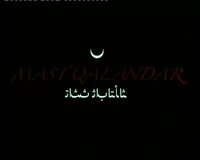
ES ES-OVNI CTX-S012-SS001-0003
·
Item
·
2005
Part of Non-Identified Video Observatory (OVNI)
Above all, Mast Qalandar (Ecstasy) is a look at heterodoxy and a celebration of its existence. Qalandars are a Sufi brotherhood of roaming dervishes who once ranged through an arch that crossed Asia, from Turkey to Pakistan and India. They are characterized by extreme mystical devotion and their revolutionary and anti-dogmatic attitudes within Islam, such as use of hachis and the rejection of alcohol and free submission to Haqq, the truth, which they see as the absence of limits rather than something which narrows and defines horizons. “Mast Qalandar” immerses us in the ritual encounter of these dervishes around the grave of the brotherhood's founder in Pakistan. A vision of heir devotion to “the beloved” that leads them into trance and ecstasy, where death means simply to “draw aside a veil”. Available online until December 27th 2020.
Untitled
ES OVNI RSC-1308
·
Item
·
2002
Part of Non-Identified Video Observatory (OVNI)
The markets of Fez, accessible from the main streets of the medina, are mostly situated very near the entrances to the city and reflect the vitality of an economic microsystem associated with the basic needs of the medina and its immediate rural surroundings.
ES ES-OVNI CTX-S013-SS004-0003
·
Item
·
2005
Part of Non-Identified Video Observatory (OVNI)
“The opening of a Muslim oratory in a building in Santa Coloma de Gramenet (Barcelona), for the celebration of Ramadan in October 2004 sparked a confrontation with dye intolerance among the residents of the city and the City. No Mosque! is a documentary of dialog and reflection that analyzes causes and consequences of this conflict on the basis of testimony of all of its protagonists.” We see the escalating pressure from one section of the neighborhood, the solidarity of others (the Ateneu Popular), the pathetic response of the City Council and the Muslim community's banishment to a prayer room made from shipping containers among wire fences in an Industrial Zone... A fractal that is being repeated exponentially throughout the country.
Untitled
ES ES-OVNI CTX-S013-SS007-0115
·
Item
·
2002
Part of Non-Identified Video Observatory (OVNI)
“My spiritual journey had taken me from the land of Ahuramazda to the realm of Allah. I came to believe there is only one God, the God of light, goodness and joy. A God who abides not on the mountains or in the oceans, nor the cities or the sanctuaries, but in the human souls who worship there”. Aryana Farshad.

ES ES-OVNI CTX-S013-SS007-0083
·
Item
·
2009
Part of Non-Identified Video Observatory (OVNI)
Puerto Rican American rapper Hamza Pérez ended his life as a drug dealer 12 years ago, and started down a new path as a young Muslim. Now he's moved to Pittsburgh's tough North Side to start a new religious community, rebuild his shattered family, and take his message of faith to other young people through his uncompromising music as part of the hip-hop duo M-Team. But when the FBI raids his mosque, Hamza must confront the realities of the post-9/11 world, and challenge himself.