Showing 120 results

Archival description
29 results with digital objects Show results with digital objects
Winter’s End
ES ES-OVNI CTX-S020 · Series · 2020
Part of Non-Identified Video Observatory (OVNI)

Observatory Archives 2020

/ CONTEXT 1994 - 2020

Observatory Archives 2020

Founded in 1994, OVNI (Observatorio de Video No Identificado) is a video-based research project that focuses on the analysis and critique of a significant part of contemporary culture. Created by video makers rather than cultural managers or curators, OVNI has always shunned the stereotype of the competitive festival and new releases. It is a project run by creators about creators who use the medium of independent video, in which creative practice has always been imperative. With the birth of the Observatory Archives in 1999 as one of its milestones, OVNI has witnessed three crucial decades, observing the birth of the internet, the transition from analogue to digital, and the tectonic shifts in the political and spiritual strata of contemporary culture. All of which have been reflected in its archives.

In 2020, OVNI offers a collectively mapped itinerary through this period. Under the title “ WINTER'S END ”, it presents four sessions of video-reverie, in a programme that subtly speaks of being adrift in the present moment and of memory. The title refers to a notion that is evocative, but also, more specifically, given the dates of the sessions, to the last days of winter and the transition to lightness. A concreate reference in overly volatile times, an evocation in times of loss.

Winter's End is held in memory of Toni Serra-Abu Ali, who met with death on 21 November 2019. Co-founder of OVNI and author of an important and extensive video oeuvre, the OVNI 2020 programme is guided by some of his works: each session begins and ends with one of his videos, in line with the thematic thread of each day’s programming. But it also includes many of his lesser-known titles, some made under a pseudonym, others anonymously.

Winter 's End- OVNI 2020, is not a retrospective or a representative survey of the Observatory Archives: that would be entirely impossible given the extent of the collection. However, at a moment in its history very much marked by Toni’s death, twenty-seven years after its foundation the Observatory is taking its extensive collection as a starting point for a particular reading. A look at fundamental questions and fragments, witnesses, and landscapes from these decades, which connect and establish a dialogue with a chaotic present presided by loss.

Without focusing on a clearly defined theme, Winter's End contemplates the drifting of the present in a programme marked by loss, in a space of time of attentive reading and of slowness, based on a desire to recover an intimate relationship with images.

Sensing the Twilight (day 1)

The first session of OVNI 2020 presents video portraits from the 1980s and 1990s, video diaries, people who talk to and with the camera on their own, in the low resolution and slower pace of analogue times. We observe video as it was then, more naïve, and therefore with a greater sense of freedom in relation to the media, through works made in pre-digital times, when the explosive spread of social media was still undreamt of. Pieces like Iñaki Álvarez’s El Dolor (1996), in which a group of people talk about their notion of pain, alone except for the camera; Xavier Hurtado’s Interview Agency (1992), a project in post-Olympic Barcelona that reveals the tension between the interviewer-cameraman and the interviewee, between transparency and manipulation, ideology and neutrality. Works that were particularly significant at the time, also in OVNI programmes in the 1990s, as was Ardele Lister’s Split (1981), in which a teenager talks about running away from home, and It Happens to the Best of Us (1989) in which she looks back on the episode as a young woman eight years later.

Crossing Mirages (day 2)

The second day of OVNI 2020 is a session that moves between loss and oblivion, illusion, and, finally, recognition in the essence. It includes important works like Marcos on Media (1996), which addresses the role of the independent media in the decade of globalisation; Una Cruz en la Selva (2006), a look back at colonised Guinea through historical archival materials, and Now I Become Death (2012), a reconsideration of Openheimer’s words after the first nuclear test, both edited by Toni Serra under a pseudonym. This second session swings between dreamlike moments and more concrete references situated in specific historical and geopolitical realities. But they all lead to the dissolution of materiality in Satsanga, en compañía de la realidad (2012), Toni Serra’s study on the non-dualistic nature of reality based on archival footage of Sri Nisargadatta Maharaj. This fundamental questioning of experience and its origin in unity is one of the core themes of the research at the heart of the Observatory Archives over the years.

Arriving at Memory (day 3)

A third session rounds off the main section of the End of Winter trilogy of programmes: a spectrum ranging from the notion of the personal relationship with the image, the media versus intimacy, and the days of “analogue naivety”, to the period of the consolidation of globalisation and the digital boom, by way of the true nature of reality and the exploration beyond the drifting moment in which we all find ourselves in one way or another, individually or collectively. On this third day, works like Toni Serra’s 7 Contemplaciones (2016), Till Passo’s Mast Qalandar (2005), and Dee Dee Halleck’s Bronx Baptism perhaps share a sense of devotion, community in unity, and contemplation as the path to becoming the other.

There is a fourth programme that we like to call the “Opening” session. Perhaps an opening up to times and spaces that will come in our interaction and continuity with the world. In any case, it is a session dedicated to Toni Serra-Abu Ali, with his works Al Barzaj (2010) and En el Camino de las Abejas (2018), which was his last video, made for the exhibition Beehave at the Fundació Joan Miró, OVNI 2020 Opening also presents two special titles in the archive, Xavier Hurtado’s Pi'txi (Acompañante) (2010) and Keith Sanborn’s For the Birds (2000).

OVNI Archives – Observatorio de Vídeo No Identificado

Rosa Llop, Simona Marchesi, Joan Leandre.

Violence
ES ES-OVNI DIF-S010-SS002 · Subseries
Part of Non-Identified Video Observatory (OVNI)

In front of a vision of the multiculturalism as a space, predefined and consensual by power, institutions and violence, the "other" is enclosed in allotments.

Toni Serra *) Abu Ali
ES ES-OVNI TS-S002 · Series · 2019
Part of Non-Identified Video Observatory (OVNI)

Toni Serra *) Abu Ali

/ VIDEO ESSAY 2001-2016 /

/ THE BLACK TAPES / TV CODE /

/ EL HAMDULILLAH TAPES * PIRATE UTOPIAS & EUROPEAN RENEGADOES /

/ THE RAIN IN DUAR MSUAR /

Entre el Agora y la Frontera

Toni Serra *) Abu Ali

/ TONI SERRA *) ABU ALI

The sheaves of wheat hide the thorns of the jujube... drops of blood are sown in the dust

the woman's belly enters full moon... announcing a still-distant October

the harvest is a time of Remembrance, of gratitude.

The Purple Meridians
ES ES-OVNI EXP-S003 · Series · 2021
Part of Non-Identified Video Observatory (OVNI)

The public presentation

The Purple Meridians is a joint project by three organisations in Spain, Italy and Turkey that brings together eighteen women filmmakers, six from each country, to debate the difficulties faced by women working in the filmmaking industry and wider screen sector. The aim is to share strategies for overcoming common obstacles and set up a support and exchange network for future partnerships crisscrossing Europe from east to west.

The project is made up of three workshops, an online roundtable, onsite screenings in Barcelona, Turin and Diyarbakır and an online programme featuring a selection of films by the participating filmmakers. The films, subtitled in English, will be made available on the streen.org platform, free of charge on the first day (to be decided on the basis of the onsite screenings) and then on a pay-per-view basis for three months.

Once the onsite and online workshops have been held in Barcelona, Turin and Diyarbakır,  each group will watch the videos of the workshops held by the other two groups and draw up a set of conclusions to share at the online international roundtable.

The filmmakers resident in Catalonia ( Anna Giralt Gris, Raquel Marques, Pilar Monsell , Ro Caminal, Lara Vilanova i Lili Marsans) will meet at the Centre Cívic Pati Llimona , where they will connect with Turin (as part of the Torino Film Festival) and Diyarbakır (Turkey).

OVNI, Mostra de Films de Dones i l’Alternativa will present a programme of films made up of two films by each of the eighteen participating filmmakers.

The remaining shorts will be screened on the same day on a continuous loop on a monitor at the Pati Llimona Civic Centre.

All the films will be available from 3 December in their original language with English subtitles on purplemeridians.org .

1- Spain Workshop (onsite)

     Monday 15 November , 4 pm to 8 pm

    Sala Raval, CCCB, Not open to the public

2- Spain Workshop (online)

    Monday 22 November , Not open to the public

3- International Roundtable (online)

    Saturday 27 November, 11 am to 12.30 pm

    Open to the public, The roundtable will be held in English

4- The Purple Meridians Screenings

    Thursday 2 December , 6.30 pm to 8.30 pm

    Centre Cívic Pati Llimona, Free admission

    Films in their original language with Catalan subtitles

The Purple Meridians is a joint project by three organisations in Spain, Italy and Turkey with the support of 2021 Eurimages Gender Equality Sponsorship.

http://purplemeridians.org/

http://purplemeridians.org/

The Observatory Archives
ES ES-OVNI CTX-S008 · Series · 2002
Part of Non-Identified Video Observatory (OVNI)

Observatory Archives 2002

The Observatory Archives

/ CONTEXT 1994 - 2020

Observatory Archives 2002

The AObservatory Archives cover a huge range of works that are very different from one another, but share a commitment to freedom of expression and reflect on our individual and collective fears and pleasures. Together, they offer a multifaceted view, thousands of tiny eyes that probe and explore our world and announce other possible worlds. It is a discourse that above all values heterogeneity, plurality, contradiction and subjectivity, an antidote to the cloning and repetition of the current corporate mass media.

The Colonial Dream
ES ES-OVNI CTX-S011 · Series · 2006
Part of Non-Identified Video Observatory (OVNI)

Autonomous Zones _ OVNI 2006

Colonial dream - Autonomous zones Archive

/ CONTEXT 1994 - 2020

Autonomous Zones _ OVNI 2006

The Colonial Dream_ Autonomous Zones

Colonialism and Eurocentrism are often discussed as though they were things of the past, fortunately overcome. But in life under globalisation, the reality seems to be just the opposite: the occupation and destruction of other worlds and cultures, systematic exploitation of their resources... and also aggressions at the local level, real-estate violence, colonial tourism, migra...

Autonomy and no-zones: other ways of perceiving and creating community-based external realities and subjective inner ones. Autonomous ways of living and thinking, zones without limits, no-zones.

After the OVNI 2005 program Resistances (1), we thought it was necessary to deepen the critical intent of the Observatory Archives through documents that reflect upon some of the roots of the situation we are currently living in. Many situations described in the videos that we screened can be traced back to the colonial pulse, either implicitly or explicitly. Similarly, Eurocentrism and the idea that all progress - even revolutionary progress- must pass through the European experience or take it as an unavoidable reference, are still present in conservative thought, and also, in a worrying and paradoxical way, in dissidence. We also wanted to go beyond the negativity that taking a position of resistance necessarily entails, and to show and share the communal and personal affirmations that are being produced in many societies and cultures, and all around us.

The Colonial Dream*Autonomous Zones sets out on a search that was already implicit in the Archives under different names, an undertaking that will naturally be conditioned by our limitations in the face of such an enormous and complex subject. This first approximation that we share with you now would not have been possible without the many contributions and collaborations that we've received - help in locating particular documents and also finding a direction within the search. In any case, our aim is not to build up a collection of historical documents, or provide a catalogue of specific events, tasks that we would be unsuited for. Rather, given the nature of the Observatory Archives, we want to offer a selection that provides some of the keys and fractals of the subject. This selection is complemented by presentations from some of the people and collectives who have shared the investigation with us or are fundamental points of reference within it, such as the ContraPlano - LAD working group, Michael Taussig (Lecturer at Columbia University and author of Mimesis and Alterity, Shamanism, Colonialism and the Wild Man ...), Serra Ciliv (!f.Istanbul Festival) and René Vautier ( Afrique 50, Algeria in Flames, Hirochirac. ..).

Our search for contemporary news and promotional materials (from 1930 to 1965) that are key to understanding how the imaginary of the time was constructed led us to some of the major audiovisual archives in the world (storehouses of the colonial legacy). Through our contact with them we came to understand the workings of something that is part of the collective memory of mankind, and how such places are managed. "Management" that is largely governed by the criteria of financial gain. Ignoring such things as non-profit, educational, etc criteria, offensive rates are applied to the extent, for example, of charging up to twenty thousand euros for screening 30 minutes of material (2). Private archives, public archives managed by private companies, or public bodies that are run according to similar criteria prevent free access, or any access, to the audiovisual material that, in this particular case, adds up to a catalogue of evidence against Europe's supposedly civilizing impulse; and a "bank" of the arguments that are still applied even now to current crises. The discovery of how difficult it is to access this material made us aware of the urgency of demanding and defending public access to these archives, which, as we said, form part of the collective memory of mankind. And to prevent the same thing happening in future with the material that is contemporary to us now.

We don't claim objective truth for the government and corporate documents, or from those by independent authors or groups - "Film is not now nor has it ever been the technology of truth. It lies at a speed of 24 frames per second. Its value s not as a recorder of history, but simply as a means of communication, a means by which meaning is generated. The frightening aspect of the documentary film is that it can generate rigid history in the present in the same manner that Disney can generate the colonial meaning of the culture of the Other. Whenever imploded films exist simultaneously as fiction and nonfiction they stand as evidence that history is made in Hollywood" (3). In reality, what we're showing are not historical events, but images. And even then, the images can't be pared back to the documentary value of the imaginary they create, images that are real in themselves and not in relation to what they represent. "Imaginary" realities - but not any less real for it. Rather than responding to the criteria of true or false, these images respond to the who, how and for what they were imagined.

In his 1951 film Afrique 50 against savagery, colonialism and exploitation, René Vautier breaks with the complicity of most documentaries and news reports filmed in Africa at the time, full of "greedy lies and fraudulent complacencies". In his words: "Look what lies in store for the people of Africa: we're in Palaka, in northern Ivory Coast. The village couldn't pay the colonial taxes: 3700 francs! On February 27, 1949 at 5 am the troops came, surrounded the village, fired, burned, murdered (...) On this African ground four bodies, three men and one woman, were murdered in our name. In the name of the French people! It's mind blowing: burnt houses, massacred townspeople, dead cattle rotting in the sun. Friends, colonialisation here is just like anywhere else, its run by vultures." These reflections led to 13 lawsuits, a year in jail and the film being banned in one way or another for 50 years.

In a different way, in Les Maîtres Fous Jean Rouche shows us how there are other ways of conspiring against colonial domination, when direct confrontation isn't possible. Or in Moi, un Noir , how a group of Nigerien migrants would rather return to the "poverty" of their country than struggle to survive in the "wealth" of the colonial paradise.

First Contact shows archival images of the first time the indigenous tribes of an area of New Guinea came into contact with white man, and contrasts these images with the situations taking place now.

In Les Statues meurent Aussi, Alain Resnais and Chris Marker look at how difficult it is to dialogue or simply understand other countries from a Eurocentric position, and how other cultures are subjugated to the "colonial" gaze.

The colonial imaginaries, made up of images filmed by the colonial powers as a testament to their work and their value, are also reflected in the material on the ex-Spanish colony of Equatorial Guinea that was made available to us by the Filmoteca de Catalunya and reflects the obsessions of the times: the task of Christianisation, the idyllic idea of bringing progress to new lands, the enthusiastic hunt for wild animals, the felling of trees, the militarization of life. Vincent Monnikendam also deals with these and other more complex issues in Mother Dao , one of the most enlightening and poetic visions of colonial realities, constructed entirely from images filmed by the Dutch colonisers in Indonesia.

The spectacular directions of this vision already appear on the European continent at the end of the 19th and start of the 20th centuries, with the Colonial Exhibitions that t

ES ES-OVNI CTX-S018 · Series · 2016
Part of Non-Identified Video Observatory (OVNI)

[ migra and coloniality ] / OVNI 2016

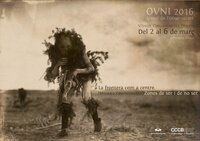
The Center as the Border. Zones of Being and not Being

/ CONTEXT 1994 - 2020

[ migra and coloniality ] / OVNI 2016

PROGRAMA CASTELLANO PDF

Videos Talks Debates.

The border has a tendency to spread: it explodes into outsourcing to third countries, and implodes as domestic borders, control devices, detentions and disappearances...; in other words, it tends to occupy the entire system, becoming centre. In the shadows of the border-as-system, where control is out of control, the prototype of a totalitarian society is assembled.

Around the subject of migration there are a series of crucial lapses or ‘forgettings’, which not only hinder in-depth reflection but also fuel exclusionary visions There first of these is the colonial lapse – we have forgotten the close ties between migration and coloniality, and its global mutation. The second lapse springs from limiting our reflections on migration to the spheres of politics, policing, economics, demographics and humanitarian action... but rarely considering it in terms of knowledge and wisdom, of which we are truly in need. A third lapse consists of labelling people “immigrants”, creating the corresponding imaginary and confining them within it... failing to remember that all of us in fact migrate between different territories, spaces, times, and forms of knowledge.

Centre de Cultura Contemporània de Barcelona

Montalegre 5. 08001 Barcelona

Rhizomes
ES ES-OVNI CTX-S013 · Series · 2009
Part of Non-Identified Video Observatory (OVNI)

Liberated spaces / OVNI 2009

/ CONTEXT 1994 - 2020

Liberated spaces / OVNI 2009

OVNI Rhizomes lays bare the subterranean, rhizomatic points of contact between worlds and experiences that seem very different from each other. The remembered image is that of a rhizome (1), or rhizomes, it doesn't matter which because it is both at once, the singular and plural do not affect it.

“Advice, slogans: follow the plants” (2). In a world of concrete and asphalt we see different plant species living in cracks in the most unlikely places, gathering rain and seeking out soil that has been banished. At other times, these same plants, or the roots of trees, create the cracks and buckle the asphalt. We have also seen plants cover entire buildings, opening walls and destroying them; but so have we seen them holding together the ruins of immemorial knowledge, ancient temples in the jungle, in a strange union that seems to complete them. Like the cobra that saw Buddha meditating and instead of biting him, decided to cover him and shelter him from the rain. An image that perhaps renews a forgotten pact: to awaken to the smooth continuity between nature and human, between nature and knowledge, a continuum that hovers over words to remind us of the essential unity and manifest multiplicity of all things.

Plants also show us diverse systems. Along with the centralised and hierarchical organisation of the roots of trees, there are the spidery roots of shrubs and bushes, the rhizome of certain species (grass, reeds, ginger, mangroves...) creates "an acentred, nonhierarchical and nonsignifying system without a General and without an organizing memory or central automation, defined solely by a circulation of states" (3).

We screen videos like visions that connect and interrelate these states and realities, producing rhizome in space, but also in time, given that the first two principles of the rhizome are connection and heterogeneity: any of its points can and must be connected to anything else. This is not the case with trees and roots, which always fix a point, a particular order. Thus, like a violently smothered echo, the Black Panthers’ "all power to the people” resonates in the possibility of immigrant communities, in the “banlieues" of the world. The anti-Vietnam war protests and the underground that derived from them emit lines that break the sad, or even complicit, silence around the occupation of Palestine, Iraq, Afghanistan... or around the wars "subcontracted" by big corporations in Africa. (4)

Indigenous peoples are part of a rhizome that includes the earth, plants and animals, forms of knowledge that derive from their forms of survival and celebration, and wakefulness and dreams. They see this multiplicity as a substantive, not an accumulation: another of the principles of rhizomes. They know that an attack against any one of their realities is unavoidably a prelude to other acts of violence. This is why a Yaqui Indian explains that those responsible for the genocide against his people also exterminated wild animals, domesticated others, imprisoned the survivors of his people in reserves. It is also like the indigenous community in Peru that dreams up a different kind of schools, and creates them with urgency on awakening; because they seen how the official educational system teaches their children to be enemies of their own traditions, of their own environment. They warn us, they are not isolated points on the outside of the “other”, they are lines of alert, for ourselves (5).

In Europe, the warning came from Exarchia, a neighbourhood in Athens. The death of 15 year old Alexis, shot by a policeman, triggered a new awareness, the occupying of spaces, the issuing of communiqués in which teenagers sorrowfully condemned the submissiveness of many of their parents, the conformism instilled by the schools of consumption and production;... the impossibility of imagining, together, another form of existence:

“We want a better world. Help us. We are not “terrorists”, nor “hooded ones", nor the "known-unknowns". We are your children, they are the known-unknowns... We have dreams, don’t destroy them We are alive, don’t stop us Remember, you were also young once Today you run after money, you only worry about “appearances” You’ve grown fat, you’re bald You’ve forgotten We hoped for your support We hoped for your concern We wanted you to make us proud for once. But it was in vain. You lives are nothing but lies, you have bowed down You’ve dropped your pants and you are waiting to die You don’t imagine, You don’t fall in love You don’t create You only buy and sell Materialism everywhere, Love nowhere, Truth nowhere (6).

Dark roots, prisons opposite factories, maps and imaginaries that don't include us as life, neighbourhoods in ruins, third-generation migrants – forever migrants? - bombed hospitals, hundreds of dead birds by a lake, torn rhizomes.

But unlike the cuts that isolate other kinds of structures, a rhizome can be torn and cut off at any part. Rhizomes can be broken or cut without causing any harm (7), because rhizomes are made up of ruptures, they can keep functioning and even thrive in spite of these “ruptures”. This is how other nomadic maps begin, inspired by roaming cats, in the non-useful areas of cities: where abandoned sites create space for communities of cats and, and room for the dreams of the people who feed them, humans adopted by feline tribes; in urban micro deserts, jungles and ruins. Where squatted abandoned buildings become hybrid, mingling with other distant memories, scorned by speculation. Liberated spaces that come back to life, that break the Totality (8).

“What is the Totality? It is the high residue of hazardous and potentially lethal chemicals inside your fat cells. It is you shopping when you are depressed. It is you sitting inside and turning on the television or computer on a beautiful day. It is feeling you get that something is missing. It is the headache that won't go away. It is the bleeding in your intestines from years of pain alleviating drug use. It is the drugs you have take when you need an escape. The bulldozer that destroyed the woods you might have known so well. It is the towering skyscraper that makes you feel forever tiny and powerless. It is your prison, sometimes with bars, sometimes without. It is all your fears. It is the thing that has categorised you. It is the ache in your back. It is your adrenaline. The tears that pour down your face after a sad movie. It is your longing for a dramatic romance with a happy ending. It is the extinct species. It is the dying world. It is polluted air. It is the farmer killing her/himself with the pesticides that were going to make life better. It is the feeling of superiority, which supplies the reason to destroy all else.” (9)

A Totality that is always aimed at the conquest of the other. And the result is a society based on competition, on commodification and global expansion. A society that doesn’t contemplate any logic other than growth (10). A society made up of masses of solitary individuals.

Dominant thought can be recognised in power that is directed outwards. But this outward-focus does not mean that this form of power is only exercised on material forms and surfaces. Rather, it causes and forces everything that is inwardly focused – anonymous, hidden, insignificant – to flow towards the surface, be reduced to the external, reveal itself, publicise itself, to end up becoming nothing more than the outside. This is the only way that it can impose its full cartography, group and produce its identities... so that it can allocate its experts and target its goods. This outwardly-directed power necessarily dominates and subjugates the other – whether beings, territories or forms of knowledge – but also to constantly produces it, through the exhibition of images and attitudes, the unceasing creation of politica

Resistances
ES ES-OVNI CTX-S010 · Series · 2005
Part of Non-Identified Video Observatory (OVNI)

/ CONTEXT 1994 - 2020

The word resistance is starting to gain currency in places and cultures all over the world, joining those that have never stopped practicing it. Resistance implies negation, the blocking of a process or power, but it also contains an affirmation: that there are other ways of doing, thinking, living. Minorities and majorities marginalized in their own land practice it in various active and passive ways. Today, this practice is bringing together very diverse cultures and peoples, some totally unconnected, that are starting to become aware of each other, to talk of each other amongst themselves in this struggle.

These resistances with their different origins and languages are being exercised against the expansion of a hegemonic " single thought " , a single way of understanding history and progress. This is often called " the West " ,...an amorphous, symbolic concept that initially referred to Europe, in particular the old European powers called the " western powers " , and then as the economic system expanded, to the United States of North America and even its allies in the Far and Middle East. Now the West seems to refer to an economic system and the culture it produces rather than the geographic sense.

What seems certain is that the Western imaginary needed to construct itself in opposition to another even larger and less exact invention: the Orient. The idea of " the Orient " was born as a result of the expansion of the " colonial powers " , and applied equally to the entire area ranging from the Maghreb to the Far East. As a new object of desire, it joined other previously conquered " uncivilized " territories, " indigenous peoples " , or the elusive " el Dorado " , etc...

It's important to recognise that the idea of the West itself was also constructed through the negation of its own diversity and heterodoxy, the violent negation of its own history(ies), and required the invention of an imaginary and exclusive genealogy in which one period succeeded the next, unopposed: classical antiquity, the Roman empire, Christianity, rationalism, the enlightenment, positivism, capitalism...all of them reinterpreted as gentle stereotypes with no violence or edge, ready for identity consumption. And so the " classical " was redefined as aristocratic origins already dominating the proto Orient or the " Persian enemy " , the Roman empire as a cruel but unifying force, Christianity as a sometimes fanatical and hypocritical but in the end civilising force, the Enlightenment as liberating and humanist in spite of its despotism and colonising approach to knowledge. And to top it off: the idea of never-ending, linear, acritical progress; and of capitalism as the ultimate guarantee of freedom ... The gradual technological hegemony is added to the succession and has arrived to test its raison d'etre and its power.

This genealogical construction rests on the global society of consumption, and its hard core that has concentrated in the web of interests of the giant oil, pharmaceutical and military industry companies, which project a spectacular world through the mass media. A way of colonising desire and fears through images and slogans, but above all a mechanism for reversibility, in which not only success and triumph but also tragedy and disaster, even our own, are instantly turned to profit through the spectacle of consumption. In this process, the idea of a single economy based on permanent and aggressive growth and the dogma of technological euphoria play key roles. Even moderate voices calling for sustainable models don't try to depart from this radical economic model, they may modulate the degree of aggressiveness, but not growth itself. The global society of consumption is so because it consumes to the point of extinction not just products but also natural resources, people and communities.

This expansive economy is generating a state of permanent conflict with many fronts: obviously military interventions, repression, occupation. But also in the field of food: local products are increasingly playing a minority role (whether marginal or elitist) and the presence and accessibility of global processed products is increasing on the free(?) market. The concept of intensive and industrialised agriculture is literally being imposed, an idea in which all processes: genetically modified seeds, fertilisers, pesticides, etc...form a single package... The planet's natural resources are coming under the prism of private property and exploitation, not just raw materials and fuels but also water, on which speculating investments are starting to converge. Public and private medicine is infiltrated by the interests of the pharmaceutical giants, not only in the virtually undisputed empire of chemical medicine, but also in the concept of what public health implies, fighting, discrediting or ignoring preventative practices and their inescapable link with education. In fact, the education system's most utopian end seems to be ergonomic adjustment to the needs of " the market " . To introduce content or practices that are not necessarily even critical, just foreign to these needs, is perceived as noise, an obstacle.

The mass media is mainly fed by ready-made news from the few major news agencies. As a group, their effect is a constant resetting of events, which are presented as a series absurdities. They propagate the idea of a hyper-privileged West in contrast to an " underdeveloped " and always suffering world, that could only possibly be of interest as a tourist destination (and, in fact, " tourists get to the places where armies don't " ). In this way, day by day, they create a single perception of poverty and wealth. The third-world media image of a boy soldier participating in incomprehensible wars, that touches the consciences of so many, never finds its parallel in the increasingly common image of a western child devoting hours to violent videogames, with some of the best-selling games being versions of military training programs.

But in these areas too, resistance persists and is growing, not always ideologically or consciously, and in ways that are different because they respond to specific contexts, cultures and traditions that vary widely from each other. We should then speak about resistances. Some of these arise from western critical thought, the remains of shipwrecked liberating ideologies, alternative practices, new foundations and connections... Others arise from the indigenous rhizome that extends unevenly throughout the world and knows that constant aggression against the earth and nature is a self-destructive process, destroying our resources and also our knowledge. Other radical resistances arise from cultures, like the now-demonised Islamic culture, a culture that is barely known and which has suffered almost 10 million victims (1) in the last decade while the West remained largely silent,... and from many other positions, religions and practices that increasingly need the awareness of the others and mutual respect. A key dialogue for accepting our knowledge and practical diversity and for self-criticism in relation to the totalitarian, exclusive aspects that exist in almost every culture. In this respect Europe and by extension the West, in spite of the majestic role it has assigned itself in the history of humanity and the construction of freedom and human rights, can hardly claim to have a model record in terms of racial, religious or national tolerance, even compared to neighbouring cultures. Paradoxically, even some parts of current critical thought and activism too easily reproduce and extend ethnocentric criteria.

OVNI 2005 Resistances will program and then include in the Observatory Archives a series of audiovisual works (155), mostly independent documentaries, media archaeology, agit-prop,.. that tell us of different forms of resistance and conflicts. From their dive