
ES ES-OVNI RSC-1669
·
Item
·
2005
Part of Non-Identified Video Observatory (OVNI)
1326 results with digital objects
Show results with digital objects

ES ES-OVNI CTX-S012-SS007-0075
·
Item
·
2006
Part of Non-Identified Video Observatory (OVNI)
Liana Badr's documentary locates itself at the checkpoints and Wall crossings within the Palestinian Occupied Territories. Here, the control of walls, gates, and roads is always political, and seemingly simple structures serve not as means of passage but more often as obstacles to the crops, families, schools, and livelihoods of those who must endure their presence.
Non-Identified Video Observatory (OVNI)
ES ES-OVNI CTX-S010-SS005-0012
·
Item
·
2002
Part of Non-Identified Video Observatory (OVNI)
Mohamed Ramzam is a Pakistani who has earned a living delivering gas bottles in the neighbourhood of "El Raval" since arriving in Barcelona in 1990. Despite working these last 12 years Mohamed doesn't receive a salary and lives from day to day on the tips he receives from the customers. He has managed to bring his wife and three children from Pakistan and they live in a warehouse situated in the heart of this working class area where the Muslim ideas and traditions of Pakistan are held dear.
Untitled
ES ES-OVNI RSC-3264
·
Item
·
2005
Part of Non-Identified Video Observatory (OVNI)
The Future of Food has been a key tool in the American and international anti-GMO grassroots activist movements and played widely in the environmental and activist circuits since its release in 2004. The film is widely acknowledged for its role in educating voters and the subsequent success of passing Measure H in Mendocino County, California, one of the first local initiatives in the country to ban the planting of GMO crops. Indicative of its popularity, the Future of Food showed to a sold out audience of 1,500 at the Castro Theatre in San Francisco in 2004, a benefit for Slow Food, where it was introduced by Alice Waters.
ES OVNI RSC-1416
·
Item
·
2004
Part of Non-Identified Video Observatory (OVNI)
ES ES-OVNI CTX-S011-SS006-0104
·
Item
·
1981
Part of Non-Identified Video Observatory (OVNI)
A world of lunatics, visionaries, snobs, groupies, heroes, clowns and sponsors.
ES ES-OVNI RSC-4083
·
Item
·
1994
Part of Non-Identified Video Observatory (OVNI)
"THE FREETHINKER was originally conceived under the title ‘August Strindberg’ as a full-length feature film which I was commissioned to make by the Swedish Film Institute and the Swedish TV in the late 1970s. The result, a four-and-a-half hour film entitled ‘The Freethinker’, is based on the original manuscript, with many new scenes and important facets developed by the students themselves, who researched, directed, filmed, recorded, edited, costumed and principally organized the production and funding of this major pedagogical project! Among many aspects of the high standard of work by these students, was their research into social conditions in Sweden during the 1870s. ‘The Freethinker’ endeavours to show: a) how non-orthodox filmic language forms can expand our view of history, and our way of relating to people on the screen, and to each other. b) that there are ways to produce audio-visual material other than according to the rigidly centralized methods used by the MAVM. c) that, contrary to what we see on TV, there are potentially alternative processes for viewers as well - through which they can become individual participants instead of hierarchically dominated, passive receivers". Peter Watkins
Untitled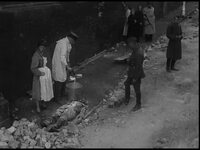
ES ES-OVNI CTX-S015-SS007-0013
·
Item
·
1960
Part of Non-Identified Video Observatory (OVNI)
n this amateur work, Peter Watkins reenacts episodes of the 1956 Hungarian Revolution and continues to develop the methods he had used in The Diary of an Unknown Soldier. As Watkins himself claims, he studied many photographs of this historic event and this probably had an effect on the number of characters who stare directly into the camera, a trait that would eventually become one of the more memorable elements of Watkins’ cinematic language. Watkins breaks away from one of the traditional conventions of cinema: the fiction that the actors aren’t aware of the camera. Paradoxically, it is precisely the reaction of the characters in front of the camera that emphasises the act of filming and destroys the illusion of the film as being faithful to reality, and produces the impression that the action that unfolds is authentic documentary. The camera shakes in the moments of violence and the image is out of focus, adopting the aesthetics of television news reports.
Untitled
ES OVNI RSC-914
·
Item
·
1993
Part of Non-Identified Video Observatory (OVNI)
ES ES-OVNI CTX-S006-SS006-0016
·
Item
·
1996
Part of Non-Identified Video Observatory (OVNI)