
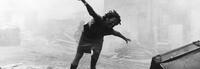
“By late 1964 Harold Wilson’s newly elected Labour Government had already broken its election manifesto to unilaterally disarm Britain, and was in fact developing a full-scale nuclear weapons programme, in spite of wide-spread public protest. There was a marked reluctance by British TV at the time to discuss the arms race, and there was especially silence on the effects of nuclear weapons - about which the large majority of the public had absolutely no information. I therefore proposed to the BBC that - using one small corner of Kent in southeastern England to represent a microcosm - I make a film showing the possible effects, during an outbreak of war between NATO and the USSR, of a nuclear strike on Britain.” The BBC panicked when they first saw the film, and sought government consultation re showing it. They subsequently denied this, but the sad fact remains that the BBC violated their own Charter of Independence, and on September 24, 1965, secretly showed The War Game to senior members of the Home Office, the Ministry of Defence, the Post Office (in charge of telecommunications), a representative of the Military Chiefs of Staff, and Sir Burke Trend, Secretary to Harold Wilson’s Cabinet. Approximately six weeks later, the BBC announced that they were not going to broadcast the film on TV - and denied that their decision had anything to do with the secret screening to the government". Peter Watkins
UntitledLetters From Beirut is an intimate, personal and powerful telling of the story of the 2006 war in Lebanon. A series of letters written by Hanady Salman - a mother living through the war in Beirut - carve a narrative arc through intense and haunting images of the conflict. She tells the stories of her family and the people she lives through the war with - the refugees, the wounded, and the everyday Lebanese, struggling to maintain their sanity and their humanity in times of war.
“The Wash is a portrait of the River Wash that runs behind the older part of Newhall, California, where Lee and I used to live. We shot The Wash on Super8 film and then finished it on video. It is a collaboration between us, describing the ways the river is used, and the people who use it, ourselves included. It charts the way this land has changed since they began developing Newhall and the surrounding community of Valencia for housing, a development that is expected to bring over 250,000 more people into the area by the year 2015.”
“Hello, I'm going to read a declaration of war. Within the next 14 days we will attack a symbol of American justice”. - Former Underground Member Bernardine Dohrn. Thirty years ago, with these words, a group of young American radicals announced their intention to overthrow the U.S. government. Fueled by outrage over the Vietnam War and racism in America, they went underground during the 1970s, bombing targets across the country that they felt symbolized “the real violence” that the U.S. government and capitalist power were wreaking throughout the world. From pitched battles with police on Chicago's city streets, to bombing the U.S. Capitol building, to breaking acid-guru Timothy Leary out of prison, this carefully organized clandestine network attempted to incite a national revolution, while successfully evading one of the largest FBI manhunts in history.
Untitledthe white dog is a single channel video work created based on Sinha's audiovisual performances using field recordings and video material collected by the artist on trips to Kolkata, India, home of his extended family. Structured in 4 parts, the white dog is a deeply personal open narrative/documentary work---a meditation on sound, image, and identity, distilled through the in/between-ness of Sinha's experience as a south Asian Canadian artist interested in how tradition can influence and inspire contemporary expression. Created specifically for the juried exhibition at the International Symposium on Electronic Art 2009, the white dog is a fixed expression of the artist's improvisational shruti performances, which use these materials in a performance context. The soundtrack was culled from various performances of shruti in Berlin, Toronto, and the Banff New Media Institute, and was reused as the soundtrack to this work. From statement by the artist: Through these multiple displacements, the place of India is brought here, to the place of the screening, mediated through my own perceptions, wrought into something approximating my own experience, a displaced person, simultaneously at home and away, everywhere.
An unusual re-visitation of William Burroughs' text.
Untitled