translate
Generally speaking, public discussion, research studies, and news reports regarding migration processes focus on exhaustively counting, analysing, describing, and questioning the migrant population. The camera spotlight, newspaper headlines, and political debates portray the migrant population as a problem to be resolved though integration, persecution, and forced expulsion, thus normalising the violence of the migration control system. This talk approaches the current situation from a different perspective, exploring the legal systems created by European governments to regularise violence against the migrant population. It also looks at the exaltation and constant defense of pro-colonial symbols and narratives as a means of supporting racialized structures, and the role of Europe's human rights and charity industry within the framework of systematic violence.
UntitledThis documentary challenges the social bases of domestic violence by showing the strategies used by women who work in the legal system, in the gaps left where there are no longer traditions, beliefs or state or religious laws. It is an epic everyday struggle to defend women, but also to convince poor women of their rights. Sisters in Law is a fascinating look at the work of a courthouse in a small town in Cameroon, Central Africa. The tough-minded state prosecutor, Vera Ngassa and judge, Beatrice Ntuba, are helping women and children to find the courage to fight difficult cases of domestic violence and child abuse despite pressures from family and their community to remain silent. Through their emotional stories and courage, the extraordinary work of women in the judicial system shines through. With fierce compassion, the female prosecutor and judge dispense wisdom and justice in fair measure; handing down stiff sentences to those convicted. Sisters in Law presents another reality of African Women’s agency and their resilient spirit, courage, hope and fight for justice and gender equality.
Untitled4 Mostra de Vídeo Independent de Barcelona 1997 & Fenòmens interactius
UntitledThe conceptual twin to Imago, Sitting is Believing continues an exploration of the architectural space of incubated desire & urban portraiture. This time the stationary, frozen element is an object. The video consists of a series of portraits of abandoned prams in public places embodying a familiar urban condition.
Size 36 is an essay about the norm - the first of a project participated by other artists. Nine women put on a size 36 set of clothes. 36 is the ideal size for women in Portugal, the one «young people's» stores sell the most.«Go from a 42 to a 36 in 8 weeks», magazines propose. Although we try to normalize our body it tends to rebel against norms...
My skin is a part of me. When seen by the outside world, it becomes who I am. But it is not the totality of me. skin is a meditation on the visual interface of my body to the world. It is an effort to present what is present, but also to express what is not. It is a possibility of identity, an expression of the seen and the not seen. The creation of this video work arose from the act of recording of the handling of contact microphones for an audio work. It seemed to me that my effort to incorporate the sound of my hands into an audio piece was not telling the whole story. I needed to acknowledge that my skin, the element that was being recorded, told its own story that was accessible only in the visual realm. I was compelled to activate the sense of sight to tell the story of my efforts to be seen as an artist who wishes to incorporate the overtones of being a visible minority into his artistic practice in unexpected ways. My training in traditional music and percussion systems, my upbringing as a South Asian Canadian with strong roots in India, and my love of technology have resulted in a practice that sees the value of tradition. It is a necessary construct, both in the creative process, and as a potential for creating work that reaches beyond it. My work is not a rejection of tradition (as system/social expression) but an envisioning of it to be more than an end in itself. The social and political realities of our individual and collective culture are too complex to either be “embraced” or “given up”. We need a nuanced and subtle dance with our distinctions, a complex relationship that allows for a reaching beyond of the bounds they supposedly imposed. From the Cineworks (2008) exhibition: Debashis Sinha's skin uses anatomy (which means 'to cut up')......skin is a lush and hypnotically absorbing screen of subtly shifting pixels in the interpretation of colour detailing the surface of a hand. Ambiguous forms unfold accompanied by an electronic, fluttering pulse. The piece marries skin surface with screen surface. By naming the colours on the screen, more dissection takes place.
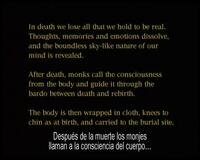
One of the funeral rites commonly practiced in Tibet is the Sky Burial, an ancient tradition that reveals a profound respect for nature and understanding of life. The Sky Burial ritual is known "jha-tor", which means the giving of alms to birds. The bodies of the dead are offered to vultures in a gesture of kindness towards living beings... a final act of generosity. We witness this funeral ritual from the Drigung Monastery in northern Tibet. To the Tibetans, merging with the sky after death is a holy event that replaces the sufferings of this world with peace.
Untitled