
Today we experience a deepening crisis in every sphere, which urges us to rethink our acceptance of the most basic social institutions. The division of labor and domestication, the cornerstones of civilization itself, need to be problematized. The absence of fundamental critique would mean that we accept an unfolding, multifaceted disaster as merely inevitable. Might we find a new paradigm/ framework/vision that breaks out of the confines of failed earlier approaches to health and liberation? Keeping in mind that there should never be a single “correct” path, there is much promise in what is called anti-civilization theory, primitivism, and green anarchy in various parts of the world. Mass society and its technological imperative are now increasingly seen as the problem, not the solution. John Zerzan is an anarchist author and activist, and an editor of Green Anarchy magazine. His writings include Elements of Refusal (1988, 1999), Future Primitive (1994), Running on Emptiness (2002), and Twilight of the Machines (2008). He has also edited Against Civilization (1995, 2002) and (with Alice Carnes) Questioning Technology (1991).
A documentary about Cuba, made in a moment of boom of the rafters.
In Jean Luc Godard film "Vivre sa vie", I heard a small dialog that talked about the nature of the hens and their soul. From this text borned the idea to animate the body of a quail ready to be cooked, and, following Godard, find in him the soul of the ballerina posthumously.
translate
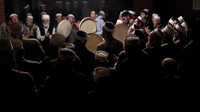
Abubakar is 46 years old and participates in the Zikr - ritual dances performed by Chechen Sufi Muslims. At each Zikr he reaches a state of ecstasy. For Abubakar it is an exorcism, a form of liberation from everything that his people have suffered over so many years of occupation. It is an act of resistance where they reunite with their dead. An encounter with the Real.
Untitled
You can't buy happiness. The other side of desire.Any new label worth the name needs a proper launch. YOMANGO, fashion sector, organized a catwalk in the centre of Barcelona, the heart of the city's commercial and tourist district, as part of an important cultural event?.
In Benyounes forest, “la foret” as they called their habitants, was the last stage of a long trip for thousands of people coming from Sub-Saharan Africa. Close to the fence that divides Ceuta (Spain) from Morocco, they establish in a variable time, before flank the last obstacle in they way to Europe, looking for a better life. Sometimes running away from wars, politics persecutions, hunger or a precarious economy situation. Lots of times of all of this. In years, the migrants pass across this forest and after some weeks or months they manage to arrive to Ceuta. In finals of 2004, European union start agreements of subcontract Morocco in the control of the Spanish – Moroccan border. The habitants of the forest, started to feel the effects of this agreements: the increase of illegal devolutions, the abuses from the civil police, they install police controls near the forest, they forbid the access to current water, military attacks to the camps in with they made mass arrests and rapes as a war weapon. The border it's close. Systematic violation of human rights, financed with the tax of the democratic European Union citizens. The migrants organize themselves in spaces like this and construct spaces; support nets in Moroccan territory, confronting and resisting this way the European politics. In the forest of Benyounes, they organized themselves from origin communities. In February of 2005, decided between all the community's, record this video, to made visible their situation, in with they report the systematic violation of their human rights, the absolutely abandonment from the NGO's, Associations an Human Rights Institutions, an they demand their citizens condition and they require their rights as human beings.
UntitledThe story of a failed encounter between two cultures with different sensitivities and fantasies. This led to colonisation - one marked by brutality - despite the fact that wars, chaos and destruction could have been avoided. Based on archive footage, the film sends a chant echoing infinitely through time and space: "France is our homeland".
Untitled