
Showing 12 results

Archival description
8 results with digital objects Show results with digital objects
ES ES-OVNI CTX-S015-SS007-0006 · Item · 1965
Part of Non-Identified Video Observatory (OVNI)

“By late 1964 Harold Wilson’s newly elected Labour Government had already broken its election manifesto to unilaterally disarm Britain, and was in fact developing a full-scale nuclear weapons programme, in spite of wide-spread public protest. There was a marked reluctance by British TV at the time to discuss the arms race, and there was especially silence on the effects of nuclear weapons - about which the large majority of the public had absolutely no information. I therefore proposed to the BBC that - using one small corner of Kent in southeastern England to represent a microcosm - I make a film showing the possible effects, during an outbreak of war between NATO and the USSR, of a nuclear strike on Britain.” The BBC panicked when they first saw the film, and sought government consultation re showing it. They subsequently denied this, but the sad fact remains that the BBC violated their own Charter of Independence, and on September 24, 1965, secretly showed The War Game to senior members of the Home Office, the Ministry of Defence, the Post Office (in charge of telecommunications), a representative of the Military Chiefs of Staff, and Sir Burke Trend, Secretary to Harold Wilson’s Cabinet. Approximately six weeks later, the BBC announced that they were not going to broadcast the film on TV - and denied that their decision had anything to do with the secret screening to the government". Peter Watkins

Untitled
ES ES-OVNI CTX-S015-SS007-0012 · Item · 1968
Part of Non-Identified Video Observatory (OVNI)

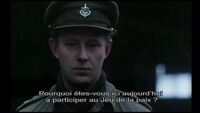
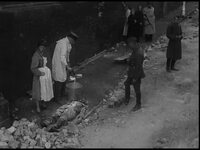
The Gladiators is a bleak satire set in the near future, in which the major powers of the world, East and West, aligned and non-aligned, recognize the possibility of a major world war within our lifetime and try to forestall it by channelling man’s aggressive instincts in a more controllable manner. They do this by forming an International Commission along the lines of the United Nations, dedicated to fighting a series of contests between teams of selected soldiers from each country. These competitions, which can be fought to the death, are called “Peace Games”, and are broadcast on global television via satellite - complete with sponsors and commercials. The film follows Game 256... The international group of officers watching Game 256 decide to eliminate a man and a woman from opposing teams who reach out to each other, because they decide that such forms of communication would be the gravest threat of all to the stability of the existing world-system.

Untitled
ES ES-OVNI RSC-4083 · Item · 1994
Part of Non-Identified Video Observatory (OVNI)

"THE FREETHINKER was originally conceived under the title ‘August Strindberg’ as a full-length feature film which I was commissioned to make by the Swedish Film Institute and the Swedish TV in the late 1970s. The result, a four-and-a-half hour film entitled ‘The Freethinker’, is based on the original manuscript, with many new scenes and important facets developed by the students themselves, who researched, directed, filmed, recorded, edited, costumed and principally organized the production and funding of this major pedagogical project! Among many aspects of the high standard of work by these students, was their research into social conditions in Sweden during the 1870s. ‘The Freethinker’ endeavours to show: a) how non-orthodox filmic language forms can expand our view of history, and our way of relating to people on the screen, and to each other. b) that there are ways to produce audio-visual material other than according to the rigidly centralized methods used by the MAVM. c) that, contrary to what we see on TV, there are potentially alternative processes for viewers as well - through which they can become individual participants instead of hierarchically dominated, passive receivers". Peter Watkins

Untitled
The Forgotten Faces
ES ES-OVNI CTX-S015-SS007-0013 · Item · 1960
Part of Non-Identified Video Observatory (OVNI)

n this amateur work, Peter Watkins reenacts episodes of the 1956 Hungarian Revolution and continues to develop the methods he had used in The Diary of an Unknown Soldier. As Watkins himself claims, he studied many photographs of this historic event and this probably had an effect on the number of characters who stare directly into the camera, a trait that would eventually become one of the more memorable elements of Watkins’ cinematic language. Watkins breaks away from one of the traditional conventions of cinema: the fiction that the actors aren’t aware of the camera. Paradoxically, it is precisely the reaction of the characters in front of the camera that emphasises the act of filming and destroys the illusion of the film as being faithful to reality, and produces the impression that the action that unfolds is authentic documentary. The camera shakes in the moments of violence and the image is out of focus, adopting the aesthetics of television news reports.

Untitled
ES ES-OVNI CTX-S015-SS007-0015 · Item · 1959
Part of Non-Identified Video Observatory (OVNI)

In The Diary of an Unknown Soldier Watkins initiated a style of filmmaking which he has consistently developed and experimented with in all of his professional films… Watkins refused to be constrained by cinematic conventions. In this film, he freed the camera from the limitations of a fixed vantage point and forced it to take part in the action so that he could create strikingly realistic, almost newsreel-like, effects and directly involve the viewing audience in the events it was witnessing. The Diary of an Unknown Soldier, however, is not limited strictly to techniques of realism. It contains a curious, almost uneasy, mixture of expressionist and documentary styles, and one suspects that the financial and physical limitations that Watkins faced because of equipment and location problems played a major part in the evolution of this syncretistic approach.

Untitled
Punishment Park
ES ES-OVNI CTX-S015-SS007-0010 · Item · 1970
Part of Non-Identified Video Observatory (OVNI)

“1970. The war in Vietnam is escalating. Nixon declares a state of national emergency, and - we presuppose in the film - activates the 1950 Internal Security Act (the McCarran Act), which authorizes Federal authorities, without reference to Congress, to detain persons judged to be ‘a risk to national security’. In a desert zone in southwest California, not far from the tents where a civilian tribunal is passing sentence on Group 638, the members of Group 637 (mostly university students) find themselves in Bear Mountain National Punishment Park… Group 637 has been promised liberty if its members manage to evade law enforcement officers and reach the American flag posted 53 miles away across the mountains within three days. Meanwhile, in the tribunal tent, members of Group 638 - assumed guilty before tried - endeavour in vain to argue their case for resisting the war in Vietnam. While they argue, amidst harassment by the members of the tribunal, the exhausted members of Group 637 have voted to split into three subgroups: those for a forced escape out of the Park, those who have given up, and those who are determined to reach the flag...”

Untitled
Privilege
ES ES-OVNI RSC-4084 · Item · 1966
Part of Non-Identified Video Observatory (OVNI)

"In 1966, following the collapse of a film which I hoped to develop with Albert Finney’s production company, on the 1916 Easter uprising in Dublin, I was approached by John Heyman, a British artists’ agent, to make a film based on an original screenplay by Johnny Speight, which dealt with the influence of Steven Shorter, a pop star in the 1960s. American novelist Norman Bognor and I adapted the script, which we retitled Privilege, to emphasize the significance of Steven Shorter as an allegory for the manner in which national states, working via religion, the mass media, sports, Popular Culture, etc., divert a potential political challenge by young people. In case this theme appears exaggerated, it is important to keep in mind that it was set in the ‘swinging Britain’ of the 1960s, and was prescient of the way that Popular Culture and the media in the US commercialized the anti-war and counter-culture movement in that country as well. ‘Privilege’ also ominously predicted what was to happen in Margaret Thatcher’s Britain of the 1980s - especially during the period of the Falkland Islands War". Peter Watkins

Untitled
ES ES-OVNI CTX-S015-SS006-0009 · Item · 1999
Part of Non-Identified Video Observatory (OVNI)

We are now moving through a very bleak period in human history - where the convergence of postmodernist cynicism (eliminating humanistic and critical thinking from the education system), sheer greed engendered by the consumer society sweeping many people under its wing, human, economic and environmental catastrophe in the form of globalisation, massively increased suffering and exploitation of the people of the so-called Third World, as well as the mind-numbing conformity and standardization caused by the systematic audiovisualization of the planet have synergistically created a world where ethics, morality, human collectivity, and commitment (except to opportunism) are considered old fashioned. Where excess and economic exploitation have become the norm - to be taught even to children. In such a world as this, what happened in Paris in the spring of 1871 represented (and still represents) the idea of commitment to a struggle for a better world, and of the need for some form of collective social Utopia - which WE now need as desperately as dying people need plasma. The notion of a film showing this commitment was thus born.

Untitled
ES ES-OVNI CTX-S015-SS005-0007 · Item · 1999
Part of Non-Identified Video Observatory (OVNI)

We are now moving through a very bleak period in human history - where the convergence of postmodernist cynicism (eliminating humanistic and critical thinking from the education system), sheer greed engendered by the consumer society sweeping many people under its wing, human, economic and environmental catastrophe in the form of globalisation, massively increased suffering and exploitation of the people of the so-called Third World, as well as the mind-numbing conformity and standardization caused by the systematic audiovisualization of the planet have synergistically created a world where ethics, morality, human collectivity, and commitment (except to opportunism) are considered old fashioned. Where excess and economic exploitation have become the norm - to be taught even to children. In such a world as this, what happened in Paris in the spring of 1871 represented (and still represents) the idea of commitment to a struggle for a better world, and of the need for some form of collective social Utopia - which WE now need as desperately as dying people need plasma. The notion of a film showing this commitment was thus born.

Untitled
ES ES-OVNI CTX-S015-SS004-0004 · Item · 1999
Part of Non-Identified Video Observatory (OVNI)

We are now moving through a very bleak period in human history - where the convergence of postmodernist cynicism (eliminating humanistic and critical thinking from the education system), sheer greed engendered by the consumer society sweeping many people under its wing, human, economic and environmental catastrophe in the form of globalisation, massively increased suffering and exploitation of the people of the so-called Third World, as well as the mind-numbing conformity and standardization caused by the systematic audiovisualization of the planet have synergistically created a world where ethics, morality, human collectivity, and commitment (except to opportunism) are considered old fashioned. Where excess and economic exploitation have become the norm - to be taught even to children. In such a world as this, what happened in Paris in the spring of 1871 represented (and still represents) the idea of commitment to a struggle for a better world, and of the need for some form of collective social Utopia - which WE now need as desperately as dying people need plasma. The notion of a film showing this commitment was thus born.

Untitled