Though they would eventually kidnap him, the Taliban granted journalist Paul Refsdal unprecedented access. This exclusive documentary shows us a side of the Taliban we have never seen before. Today, the Taliban seem to survive mainly on conviction: "We belong to God and fear no-one". From their mountain hideout, they ambush the daily American convoys, descending into joyous shouts of "Allah Akhbar", when a truck is hit. But a hit on target is rare. And the Americans' response is swift and deadly: a US gunship kills Commander Dawran's second-in command, and Refsdal is told to flee and to return in a month. Dawran escapes unharmed, but his two children are killed.
Guerra
116 Archival description results for Guerra
Though they would eventually kidnap him, the Taliban granted journalist Paul Refsdal unprecedented access. This exclusive documentary shows us a side of the Taliban we have never seen before. Today, the Taliban seem to survive mainly on conviction: "We belong to God and fear no-one". From their mountain hideout, they ambush the daily American convoys, descending into joyous shouts of "Allah Akhbar", when a truck is hit. But a hit on target is rare. And the Americans' response is swift and deadly: a US gunship kills Commander Dawran's second-in command, and Refsdal is told to flee and to return in a month. Dawran escapes unharmed, but his two children are killed.
October 2011 is the 10th anniversary of the invasion of Afghanistan and the beginning of the 2012 federal austerity budget. It is time to light the spark that sets off a true democratic, non-violent transition to a world in which people are freed to create fair and sustainable solutions.
UntitledIn Standard Operating Procedure, filmmaker Errol Morris examines the context of the notorious Abu Ghraib photographs—how these photos exposed alleged U.S. violations of the Geneva Conventions in the interrogation of prisoners in Iraq.
UntitledSoraida is a Palestinian woman who lives in Ramallah, in the occupied territories. This video captures her personal struggle to retain her humanity in the midst of oppression. In her neighbourhood, the women do not all wear veils, the men do not rattle off empty political slogans, and the young people do not have bombs strapped to their belts. Life goes on despite the curfews and checkpoints that confine the people in a barless cage. Soraida invites us into her world, and that of her family and neighbours. Through their simple, everyday actions, we discover the worst thing about living under a state of siege: the loss of control over one's own life. In this vibrant plea against the occupation, Soraida shares her reflections on life in Palestine and her refusal to give in to the hate and violence.
UntitledSongs and images taken from video games are used as a parable to approach the Israeli-Palestinian conflict. Eddo Stern bases his work on the use of "bugs" or errors in the computer games he uses to construct his work.
UntitledA sound-bite blitzkrieg challenging the messages we have been from our mainstream media and the government it serves.
UntitledSix years after being bombed by NATO forces, Belgrade city still keeps some of the buildings as they were left by the bombs. Inside one of them, the same group of women that once use to clean and maintain it now gather together, acting and working again as if time had never moved.
UntitledPractical information
A presentation of Kurdish films by the Rojava Kurdistan Film Commune (Northern Syria)
OVNI has collaborated with the Rojava Film Commune in a project aimed at researching, screening, and promoting their work in Spain, Italy, and France. A process of investigation through videos, texts, and meetings, in order to listen to their voices and understand their struggle together. We have created a website that you can visit link.
Komîna fîlm a Rojava (Rojava Film Commune) is a collective of filmmakers founded in 2015, based in the autonomous Rojava region in the Federation of Northern and Eastern Syria. The Commune is actively working in the region to rebuild and reorganise filmmaking and film education infrastructures.
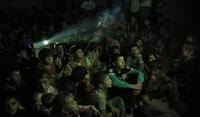
The Rojava Film Commune was established to promote local film culture by organising film screenings, facilitating discussions on the role of film within society, producing new films, and setting up a Film Academy. Following the 1960 fire in Rojava’s only cinema in the city of Amude—which saw the death of 298 children trapped inside—the Commune aims to reclaim film as a central space for reimagining society, by democratising and revolutionising the imagination itself.
The Commune has educated a new generation of Rojava filmmakers, organized screenings in cities and villages, and produced new films. It seeks to represent the values and ideals of the Rojava Revolution, but also to mediate and depict the daily struggles in the Syrian civil war and Rojava’s collective attempt to build a new society.
The Rojava Film Academy provides education for aspiring filmmakers in Northern Syria. Founded in 2015, it offers one-year programmes, with courses on international film history, Kurdish film history, film theory, photography, cinematography, script writing, editing, and sound design, taught by local and international film professionals.
The Academy is self-organized and non-hierarchical, encouraging students to participate in every aspect of its organization. Exchange networks have also been set up with other academic, media, and news platforms, and with civil society organizations, in order to engage in broad discussions and create screening possibilities. Considering the influx of foreign filmmakers and journalists to Rojava, it is important for the Commune to reclaim the representation and imagination of the revolution.
After decades of oppression of Kurdish language and culture, the Rojava Film Academy aims to revitalize local film culture, reclaiming the power to narrate and imagine one’s dreams and realities. After the Syrian Civil War started, the predominantly Kurdish northern region declared the Autonomy Administration, creating structures based on grassroots democracy, women’s liberation, and cultural diversity.
The Academy bases its methodology on ‘revolutionary realism’, i.e. a realism that does not merely reveal the current reality in a new way, but also restructures the reality of the possible . As well as finding forms to express things as-they-are, it creates the opportunity to imagine the not-yet-present, the ‘eternal becoming’ that is the revolution itself.