This documentary tells the story of how our civilization's addiction to oil puts it on a collision course with geology. The film visits with the world's top experts and comes to a startling, but logical conclusion - our industrial society, built on cheap and readily available oil, must be completely re-imagined and overhauled. You needn't be a conspiracy theorist to see a connection between America's current obsessions with the Middle East and national security, and the world's looming oil crisis. The frenzied search for alternative sources of energy now being pursued by the largest multinational energy corporations makes it clear they also believe a crisis is fast approaching...
Untitledglobalización
27 Archival description results for globalización
Various activist documentaries reporting on and responding to an extreme situation. The 'legal' sacking of a country. www.argentinaarde.org
UntitledBreaking The Bank is a remarkable independent account of the April 2000 protests against the International Monetary Fund and World Bank. Drawing on the hard work of eight activist production groups and scores of volunteer videographers, this documentary is filled with dramatic, inspiring footage from the streets of D.C. Breaking The Bank goes beyond the activists' slogans and corporate media's sensationalism to achieve an in-depth examination of the issues behind the protests.
UntitledFamous and hooded, song lyrics, the 10 secrets of success, test: how well do you organize your time, beauty tricks. An extraordinary educational videotape! It´s main goals are to provide solidarity in the face of a repressive police state and to convey an anarchist critique of whatever is being protested nowadays. Highly recommended for your schoolkids!
With breathtaking clarity, renowned University of Massachusetts Economics Professor Richard Wolff breaks down the root causes of today's economic crisis, showing how it was decades in the making and in fact reflects seismic failures within the structures of American-style capitalism itself. Wolff traces the source of the economic crisis to the 1970s, when wages began to stagnate and American workers were forced into a dysfunctional spiral of borrowing and debt that ultimately exploded in the mortgage meltdown. By placing the crisis within this larger historical and systemic frame, Wolff argues convincingly that the proposed government “bailouts,” stimulus packages, and calls for increased market regulation will not be enough to address the real causes of the crisis - in the end suggesting that far more fundamental change will be necessary to avoid future catastrophes.
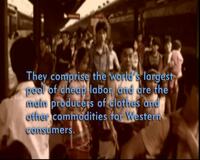
“China Blue” paints a nuanced, tender and ultimately moving portrait of the daily lives of the young workers who make our clothes. It also brings an updated and alarming report on the economic pressures applied by Western companies and their human consequences.
The clash between the State and the social movements in Spain in 2011 laid bare the true nature of power. The police crackdown was a response to the largest protest to date. Three hundred thousand demonstrators were faced with the most violent side of democracy. Using images of these events taken from various sources, this film reflects on democracy, power and its symbols, the role of the media and violence, as well as questioning the language of film and the scope of its possibilities.
UntitledImagine Apple is a state. Image that states worked like companies, or vice versa. Would you rather live in Apple or in China. This documentary poses the seemingly absurd question: What if Applewere a state? and invites us to reflect on the way companies and states operate, taking Apple and China as examples. “It is not another film about Apple or about China. By comparing two epitomes of the world, it turns out that software might be a new form of governance. But on the ground, there is real desire and real exploitation.”
Stranger than fiction... In 1998, seven years after the independence of the country, the autocratic Kazahk president Noursoultan Nazarbaiev decides to move the capital city Almaty to Astana, in the northern steppes. Vertiginous towers spring out of the ground, financed by oil exports. The film opens with a presidential speech in 1997 on the future of Kazakhstan, boasting to “the three layers of society, the rich, the middle class and the poor” of the infinite promise of the free market. Christian Barani and Guillaume Reynard observe the life of a new society, in the standardised and gaudy trappings of wealth. Through an ex-Soviet oligarchy in full expansion, a melancholy and poetic portrait of globalization.
The distorting and paranoid role of the mass media in the USA. In the United States the penitentiary system is a business, and the media act as "laundering" agents, concealing the financial speculation surrounding the prison industry.