France

Elements area

Taxonomy

Code

Scope note(s)

    Source note(s)

      Display note(s)

        Hierarchical terms

        France

          Equivalent terms

          France

            Associated terms

            France

              9 Archival description results for France

              9 results directly related Exclude narrower terms
              ES ES-OVNI CTX-S011-SS002-0010 · Item · 2002
              Part of Non-Identified Video Observatory (OVNI)

              We follow the director's camera into the kitchens and living rooms of a community of Moroccan women. inside the walls of their apartment in Casablanca's old Medina, the women cook, clean, take care of their families and help each other. With their hands in the dough, in the soap whilst washing the laundry, doing the house chores, in the market or at the hammam, between laughter and tears ("We are housewives, that's all. ... Our sport? House cleaning!"). These courageous women, proud of their role, talk about their miserable lives with a great sense of awareness, but without self-pity. They show a surprising vitality, curiosity for life and solidarity. These house-proud housewives may not all know how to read, but they know exactly what would improve their lives: equal rights for women and men, more money, and a better future for their children so they wouldn't have to emigrate to support the family. A sense of hope and the possibility of change radiate out of the everyday lives of these heroines ("batalett").

              Festin
              ES ES-OVNI CTX-S010-SS007-0064 · Item · 2002
              Part of Non-Identified Video Observatory (OVNI)

              How to escape from the trap? How to fight the monster of need that makes you lose your human shape, that itch that you can?t stop thinking about and makes that you dependent, a prisoner of consumption, a slave to an artificial paradise? All these questions are taken from the books of William Burroughs, a drug addict until he finally escaped the horrors of addiction at the age of 50. In his introduction to ?The Naked Lunch?, Gérard-Georges Lemaire, referring to Burroughs, wrote: "..he was wildly interested in control techniques in the widest sense, from the Maya Code, which he discovered in Mexico, to the manipulations of the mass media, the CIA and different American sects?. William Burroughs is a tireless defensor of the free will of human beings subject to all kinds of coercive systems, some totalitarian, others more subtle, more sophisticated, that take possession of the human being through perverse and intimate channels: such as desire, for example".

              Non-Identified Video Observatory (OVNI)
              ES ES-OVNI RSC-4323 · Item · 2021
              Part of Non-Identified Video Observatory (OVNI)

              Under the benevolent shadow of Jean Genet, buried in Morocco,  this film is a dialogue between the living and the dead, an invitation to bring those realms together, between silent humanist revolt and poetic elegy. A family takes loving care of a white tomb, in a cemetery with a view of the sea. We are in Larache, south of Tangier, where Jean Genet lived the last ten years of his life.  Today, the writer is finally home, among his own. And for the locals of the city, he is a legend.Few of them actually knew him. Still fewer have read him. Most all have reinvented him for themselves. Everyone has their own story to tell. But they all agree on onething: “Jon Joney” valued them. He was on their side. Thesesimple, poor, quite frankly invisible individuals form the voiceless and futureless people of Morocco. Living incarnations of the characters in hiswork, they now keep watch over his grave.

              Untitled
              La Caravanne de Mé Aïsha
              ES ES-OVNI CTX-S012-SS002-0007 · Item · 2002
              Part of Non-Identified Video Observatory (OVNI)

              The life story of an elderly Mauritanian woman, Aïcha Messaoud, who spent her whole life as part of Sheik Ma-el-Aïnïne's distinguished family of nomads and now lives in the small Moroccan village of Tata, in the northern part of Western Sahara. The filmmaker sets out to trace the memories of her heroine. Stage after stage, she travels through thousands of kilometres across the desert, encountering the descendants of the Sheik.

              Untitled
              Les Ciseaux
              ES ES-OVNI CTX-S010-SS007-0065 · Item · 2003
              Part of Non-Identified Video Observatory (OVNI)

              « A man and a woman make love, they share their pleasure like scissors which cross ». The pair, like a pair of scissors that is sharp, dangerous and sublime. « Les ciseaux » (the scissors) is a video made using images from the Nabil Ayouch's film « Une minute de soleil en moins », censored in Morocco. »

              Mapping Journey #2
              ES ES-OVNI CTX-S013-SS007-0122 · Item · 2008
              Part of Non-Identified Video Observatory (OVNI)

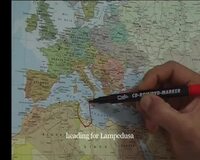
              A series of videos that trace the routes of several African immigrants through Italy to France where they have ultimately joined the French Foreign Legion. An emigrant draws on a map of the world the route he has followed. In this way, creates a bridge between the feelings of an emigrant being tossed back and forth and the superficiality of a geographical map.

              ES ES-OVNI CTX-S014-SS001-0095 · Item · 1997
              Part of Non-Identified Video Observatory (OVNI)

              Over the last twenty five years, Maghrebian immigrants living in France have brought their families to join them. Many of them lived in shanty towns before moving to working class suburbs. Their children were sent to school and grew up in France. Now their grandchildren cannot move forward, because they have lost their historical memory. This community of two million people, of whom a third have French nationality, are weighted down by double silence: the silence of their parents, and the silence of the public institutions. Mémoires d'immigrés, l'héritage maghrébin is an inside look at this community scattered throughout the four corners of French territory. Benguigui constructs her documentary by intercutting the personal and moving stories of three groups of interviewees: the fathers, the mothers, and the children.

              Untitled