
ES ES-OVNI RSC-1615
·
Item
·
2005
Part of Non-Identified Video Observatory (OVNI)
France
267 Archival description results for France
267 results directly related
Exclude narrower terms

ES ES-OVNI CTX-S011-SS006-0120
·
Item
·
1968
Part of Non-Identified Video Observatory (OVNI)
Grands Soirs / Petits Matins
ES ES-OVNI CTX-S012-SS007-0104
·
Item
·
1984
Part of Non-Identified Video Observatory (OVNI)
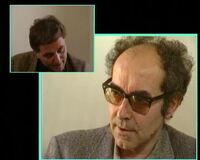
Godard / Soller L'entretien
Untitled
ES ES-OVNI RSC-244
·
Item
·
2000
Part of Non-Identified Video Observatory (OVNI)
ES ES-OVNI RSC-4328
·
Item
·
2017
Part of Non-Identified Video Observatory (OVNI)
At the beginning of the 70s, Jean Genet is in Tangier, he is in his sixties and he no longer writes. He lives in the El Minza hotel, a palace, where he spends entire days reading, smoking and sleeping (he takes Nembutal, a barbiturate used as a sleeping pill). He only goes out at the beginning of the afternoon to have a coffee with milk in one of the bars of Petit Socco. He sometimes meets the young Moroccan writer Mohamed Choukri there. Their discussion is banal, friendly. Sometimes they talk about literature. Genet no longer writes, but is still inhabited by it.
Untitled
ES ES-OVNI CTX-S014-SS001-0018
·
Item
·
2010
Part of Non-Identified Video Observatory (OVNI)
A film that recounts the situation in Gaza in the wake of Operation Cast Lead. As the filmmakers explain, “We came to Gaza the day after the start of the war and discovered the extent of the Gaza-strophy.”

ES ES-OVNI CTX-S012-SS007-0045
·
Item
·
1984
Part of Non-Identified Video Observatory (OVNI)
In the summer of 1984, mountain climber Reinhold Messner climbed two of the highest peaks in the world back to back. A film about stark and austere inner landscapes, and what compels these climbers.
ES ES-OVNI CTX-S014-SS001-0083
·
Item
·
2009
Part of Non-Identified Video Observatory (OVNI)
Is it still possible to live a nomad's life today? Can a person continue to walk on multifarious paths that lead to ever-changing horizons? How can this void be filled' These disturbing questions are all the more acute in the arid lands of the Sahara and the Sahel, as their economy is gradually smothered, their population criminalised, and their territories ruthlessly coveted for their rich mining potential. In an effort to keep chaos and meaninglessness at bay and to resist the ultimate dispossession of the self – that of the imagination – forty-four Toureg poets gathered for three days and three nights in Agadez, in November 2006. The aim of the gathering was to join forces and define resonant pathways freed from the shackles that currently immobilise their society, and to reinvent new ways of weaving a present.
Untitled
ES ES-OVNI RSC-4354
·
Item
·
1976
Part of Non-Identified Video Observatory (OVNI)
Frontline is a documentary by René Vautier about apartheid in South Africa, made at a time when almost no films addressed the subject. Banned for twenty years in France, the film offers a unique and powerful historical testimony. Through interviews, archival footage, and critical commentary, Vautier denounces the brutality of the South African regime and the complicit silence of powers like the United States, France, and the United Kingdom. Figures such as Oliver Tambo and Miriam Makeba give voice to the resistance. The film was conceived not as an artistic work, but as an educational and political tool, reflecting Vautier’s tireless commitment to all struggles against oppression.