
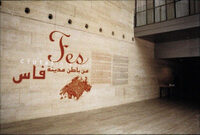
An initiatic journey Videos from an exhibition at the Centre de Cultura Comtemporània de Barcelona from March 26 to May 30, 2002 (a project by Albert Garcia-Espuche and Toni Serra). Into the innermost parts of the city of Fes.Using audiovisual recordings that illustrate some of the different anthropologic, sociologic, urbanistic and religious aspects that make up the fabric of the city. A journey that requires both objectivity (in the working method) and subjectivity (for the experience of the journey and immersion in another culture).

Fez
9 Archival description results for Fez
The urban and social structure of neighbourhoods in the medina is one of vast intricacy and complexity, being organized around a series of vital establishments for the everyday life of their inhabitants, such as the hammam or public baths, the bakery, schools and the foundouk, or caravanserai. Communal bakeries provide the heating for the public baths or hammam, fully active establishments that are very important for the cohesion of the city's social fabric. Foundouks are establishments where visiting merchants traditionally stayed and stored their products overnight. Most have now lost their original function and are adapted for other uses, such as dwellings or workshops.
An initiatic journey Videos from an exhibition at the Centre de Cultura Comtemporània de Barcelona from March 26 to May 30, 2002 (a project by Albert Garcia-Espuche and Toni Serra). Into the innermost parts of the city of Fes.Using audiovisual recordings that illustrate some of the different anthropologic, sociologic, urbanistic and religious aspects that make up the fabric of the city. A journey that requires both objectivity (in the working method) and subjectivity (for the experience of the journey and immersion in another culture).
A journey of initiation into a city and a its culture. The set of projections (10 screens) aimed to create a journey in the complex sense of the term: using audiovisual segments to illustrate aspects of the anthropological, sociological, urban and religious tissues of the city. A journey claiming both: a certain objectivity (in the working method), and the subjectivity (of the travel experience and approach to another culture). Moreover, the projections do not meet the criteria of a film with a beginning and an end, but rather the creation of a landscape, so the viewer choosed the time he/she wished to dedicated to each fragment. This made it possible to enjoy a deeper level of inquiry to specific fragments (artisans, rituals interviews, etc.). Consequently, the result of each visit to the exhibition gave an unique combinatorial fragments, since the total length of the projections would be about 6 hours. VideoInstallation 10 screens total lenght: 6h 40' Toni Serra , Albert García Espuche CCCB Centre de Cultura Contemporània de Barcelona 2002
UntitledAnonymous guide. Fes el Bali, the old medina of Fez founded in 809 by Idris II, is still completely contained within city walls. The gates (Bab Bou Jeloud, Bab Fteuh, Bab Er Rsif, Bab Guissa...) therefore retain all their social and symbolic value, associated with the different activities of the city and its inhabitants.
Fez is the Moroccan city with the liveliest tradition of artisans. Far from being "just a job", the activity of the artisan reflects a whole conception of the world and a way of experiencing time and giving it meaning. This native wisdom is passed down from parents to children, from the maalem, the master, to the apprentice.
Fez is one of the North African cities to have had most madrassas, of great architectural beauty. Madrassas, former Koran schools and now open for visits as public monuments, formerly provided one of the functions that raised Fez to the height of its splendour: the study of Islamic tradition and the body of laws and regulations governing social life. They were also the home of the students. Madrassas: Bu Inaniyya (1350), al-Attarin (1323), Seffarin (1280), al-Sahri (1321).
The markets of Fez, accessible from the main streets of the medina, are mostly situated very near the entrances to the city and reflect the vitality of an economic microsystem associated with the basic needs of the medina and its immediate rural surroundings.
From the series Fez Ciudad Interior. Silences and wind in the olive trees, contemplation, labyrinths and dreams. Abdelfettah Seffar, a craftsman who lived in London for years and decided to return, talks about Fez, a veiled city, and reflects of the West and its conflicts.
Untitled