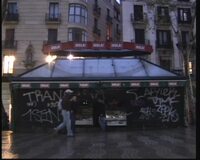
Open conversation with Toni Serra *) abu ali (OVNI Archives) and the authors of the videos of ACTE 34: The Other City: Marc Almodóvar, David Batlle and Giovanni Cioni, who will reflect on their works in particular and open discussion on the evolution of cities in the conflicts of global capitalism. Suñol Foudation, 3rd October, 2016.
España
9 Archival description results for España
“Socotra, the island of djinns” is based on the book “Socotra, la isla de los genios” published by Atalanta ediciones. The film is the story of a trip on the remote island of Socotra in the Indian Ocean, known in antiquity for its Phoenix and Rukh birds. In the rest of the Indian Ocean, the monsoon winds, have propitiated commerce and civilisation. Without any bay or natural port and surrounded by reefs, Socotra is isolated during the monsoon when is imposible to land. This isolation has preserved a unique environment. Frankincense and myrrh trees grow freely on Socotra.The dragon blood tree unique to the island has sap that is a red as blood. It was used by the gladiators of Ancient Rome to cover their skin and to protect it from injuries. The varnish that gave a unique and precious touch to Stradivarius violins, is also credited to the sap of the tree, a secret kept by the luthiers of Cremona. On the journey are Ahmed Afrar, youngest son of the late sultan of Socotra, some companions and three cameleers with their animals. They trek to the mountains before the rainy season. En route to visit relatives, the socotrians speak tell stories by the fire. During the night, conversation turns to legends of djinns and monstrous snakes that dwell in the cavernous interior of the island. A surprising and vanishing world is revealed. Is the first and only movie spoken entirelly in the genuine socotrian language, A southern arabian language related to the old language of the Kingdom of Sheba.
UntitledPlan Rosebud 1 is focused on the recent social debate around the so-called Historic Memory Act in Spain, and the current relation between the sites of memory and the politics of memory, and the cultural industries, studied in detail, in our case, trough the war tourism and commemorative tourism (that forms the main part of the four scenarios that this first film contains).
UntitledTenerife, an island paradise. Playa de las Americas, mass tourism, desire and pleasure packaged for consumption and its wreckage.
UntitledConcrete Coast is about the social, cultural and environmental effects of the last section of un-urbanized Spanish Mediterranean coast being built up for residential tourism in the Region of Murcia. Agriculture is disappearing along this 230 km stretch of coastline and being replaced by 60 golf courses, marinas, freeways and new large-scale planned communities with 1,000,000 residences, mainly for sunseeking British retirees who are set to double the population of Murcia within few years. The impacts of these large-scale economic and political forces are illustrated by a Spanish farming family having their land expropriated and a retired British couple embarking on their new life in a country where they do not even speak the language. How will all of this change the culture of the region? Will the populations integrate? Will these and other Spanish farmers have to emigrate?
Urban space in the city of Barcelona is strongly influenced by the phenomenon of tourism. Four people talk about their impressions through their experience of systematised tourism in the city and the daily life of the people who live in it. “Abandoned City” is a 26 minute documentary that that takes its title from the phrase of one of its characters, who talks about the irony of an overcrowded city affected by abandonment. A local representation of a global phenomenon. This documentary is the result of the group work of the first year of the master of visual anthropology UB-Tanios films.
UntitledA city built out of fragments found on the net. Mirages hinting at a world of ephemeral beauty and a forgotten people.
Untitled“In our century, hospitality has been replaced by the hospitality industry. When we see the word in print or we hear it from somebody's lips, it is always in the context of the commercial world: whether it be in reference to a holiday package deal, a hotel or the customer service offered by an air hostess. Hospitality has become merchandise, and luxury merchandise at that. A service provided in exchange for cash, or better still, for a signed slip guaranteeing payment by some prestigious credit card. In this world of economic trade, we are vulnerable without the shield of a Mastercard or American Express card. Only the balance of our plastic can protect us.” Hector Zagal and Julián Etienne: Sobre la Hospitalidad.
UntitledThe sun does not always shine in Barcelona, the “best shop in the world” according to the slogan of a City Council campaign. The thousands of tourists who visit Barcelona every month boost the city's economy, but their social and human impact is often overlooked. The precarious nature of jobs in tourism, real estate pressure from the hotels, and the types of problems that crop up when a city turns into a kind of theme park in an attempt to seduce outsiders. The classic problems of global capitalism, reflected in one of the country's major industries... “BCN Thematic Park” talks about all this... about Barcelona, a city-advertisement that is turning into the newest theme park on the international market.
Untitled