
ES OVNI RSC-75
·
Item
·
2003
Part of Non-Identified Video Observatory (OVNI)
España
737 Archival description results for España
737 results directly related
Exclude narrower terms
ES ES-OVNI RSC-3779
·
Item
·
2010
Part of Non-Identified Video Observatory (OVNI)
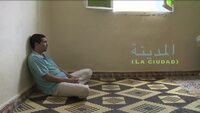
A Tuareg man sits and talks to the camera about the extermination of his rebellious people. With his face hidden and dressed in blue, he gives instructions on how to record his testimony: without his image, without his voice; from that moment, subtitles express his arguments. Tuareg historic memory is transmitted orally, translated in its transcription on the screen which explores moments from daily life and traditional festivities of this desert peoples. A silent document, with music, on the Tuareg community which is ignored by the media and is being systematically massacred by the country's army. The desert which was once an open space has become their prison. ?
ES ES-OVNI RSC-2907
·
Item
·
2008
Part of Non-Identified Video Observatory (OVNI)
The heroic characters in mainstream fiction always show individualist attitudes as a possitive matter. In this video, the heroe's individualism is taken to its complete extreme.
ES ES-OVNI CTX-S015-SS007-0004
·
Item
·
2011
Part of Non-Identified Video Observatory (OVNI)
He travelled to another land, a different sea, and was certain that he had found a better city. But he didn’t realise that his own city was travelling with him.
Untitled
ES ES-OVNI CTX-S010-SS002-0002
·
Item
·
2003
Part of Non-Identified Video Observatory (OVNI)
How I am supposed to get any ride done?
Untitled
ES ES-OVNI RSC-2938
·
Item
·
2008
Part of Non-Identified Video Observatory (OVNI)
Ali Salem Hamudi Mohamed - Yahdih, was born in 1955 in El Aaiún (Western Sahara). He completed his secondary schooling in the “Spanish” Sahara. A scholarship allowed him to enrol at the Universidad de la Peninsula in 1975, but Morocco\\\\'s invasion of the Sahara led him to return to the city of his birth and go into exile with his people, participating in the resistance and helping to organise the Tindouf Refugee Camps (Algeria). In 1980, the Polisario Front and the Government of Cuba offered him the opportunity to study Architecture at the University of Havana. On his return to the Camps in 1985 he worked for the SADR's Department of Construction. He designed more than twenty public buildings, including town halls, schools and nursery schools, and also collaborated with international aid organisations to build hospitals and training colleges. All of these buildings were built collectively by the Saharan people. In 1999 he emigrated to Spain. His family joined him five years later.

ES ES-OVNI CTX-S011-SS006-0014
·
Item
·
2005
Part of Non-Identified Video Observatory (OVNI)
Zouhair El Hairan, a Tetuan native, returns to this city, surprised by the supposed involvement of other young men from Tetuan in the 11M bombings, some of them killed in the explosion in Leganés. There he talks to different people about what happened and brings new reflections on the connection between the bombings and Islam.
ES ES-OVNI CTX-S014-SS001-0135
·
Item
·
2010
Part of Non-Identified Video Observatory (OVNI)
Al Barzaj [Between the worlds] is a poem about the halfway world, between the visible and the invisible, sleep and wakefulness... An inner journey through underground streets, secret gardens.
Untitled
ES ES-OVNI CTX-S009-SS005-0015
·
Item
·
2003
Part of Non-Identified Video Observatory (OVNI)
Documents from the dark side of the empire. Government and corporate promotional material from military, pharmaceutical, digital and other mega industries...promoting them and their unspoken interests.
ES ES-OVNI DIF-S010-SS003-0001
·
Item
·
2019
Part of Non-Identified Video Observatory (OVNI)
Fourteen young Moroccan newcomers to a reception center for minors in Spain agree to participate in a theatre workshop. It is the thin line that separates their recent past from their uncertain future. What is theatre but a full experience of the present? (2019-2001) ذكرى المرحوم عبد الصمد العبودي IN MEMORY OF ABDESSAMAD EL ABOUDI (2001-2019) Ahir/demà [Yesterday/tomorrow] family is very sad today. Extremely sad. One of the young boys who took part in our documentary, one of the protagonists, our brother Abdessamad El Aboudi, died in Barcelona yesterday afternoon. We are devastated. Together with Abdessamad, we shared the experience of the workshop given by Jesús Muñoz and Pau Pons, of the Pont Flotant theatre company, at the Reception Centre for Minors in Buñol, Valencia. He joined in with great enthusiasm. His energy was powerful. He was skilled, intelligent and very talented. During those sessions on Tuesdays and Thursdays he was happy. He also agreed to participate in the documentary we made to tell that story. In the film he could not transmit more happiness and life. Today, dear Abdessamad, son, brother, nephew, friend, we remember you. You are now a part of us.