A media city like New York is seen for the first time by the filmmaker of the documentary. In her images is difficult to distinguish between the city as an icon from what is new, unknown and surprises her. An essay about the city as a show stage and as a real environment for the life of its inhabitants.
España
737 Archival description results for España
The documentary 4 days in May, Six Months Later, deals with the Prestige affair (the Prestige was a petrol tanker that sank off the Galician coast in 2002, releasing 50,000 tonnes of low-quality heavy fuel into the sea and subsequently the coast) and its ecolological, political and social consequences.
“6 versos i poca vergonya” ens submergeix al bany d'emocions que viuen tres joves del Delta de l'Ebre endinsant-se al costum més festiu dels seus avantpassats: la rondalla. Rafa dirigeix el somni de fer reviure aquest cant improvisat de les Terres de l'Ebre i Curto i Tolet busquen la rima i l'afinació. Aconseguiran superar el pas del temps i triomfar com a cantadors? Aquest documental desperta els sentits mentre immortalitza el vent de la improvització. Són les passes de tres joves que del poble han begut han conversat amb els vells agraint-los tot el rebut i convençuts del que han fet la vergonya l'han perdut
"A Tornallom" is a documentary about the struggle to defend de irrigated area used for cultivation known as La Huerta de Valencia. It shows us images and testimonies of the events that occurred between September 2002 and March 2003, when more than 200 residents of La Punta (in the Huerta area) were evicted from their houses. The villages were demolished and the fields bulldozed to make room for the ZAL (logistics activities zone) of the Port of Valencia, which is planned to take up around 600,000 square meters, most of the area of La Huerta. “A Tornallom", is what the agricultural workers of La Huerta call the way they swap work amongst themselves. For heavy agricultural tasks workers usually help each other, pooling their efforts to do the work on one person's field and going on to another the next day until all the work is done.
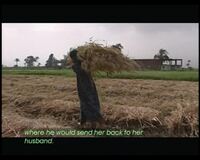
UntitledJanata Bennuna is from Morocco; Hanan Al Shaykh is from Lebanon; and Nawal Al Saadawi is from Egypt. All three are authors of the Arab word, committed intellectuals who shed light on the complex social reality of the Arab world through their books. In their hands, literature becomes a weapon through which to draw attention to and denounce situations that they oppose. The three women, from a generation heavily influenced by Pan-Arabism, initially studied against the wishes of their families, but ended up gaining their support. In A Woman's Word, these three very different writers who nonetheless share a common ground talk about their lives and their work. By learning about them, we also gain an insight into the Arab world, which is much more complex than the Manichean and mostly malicious information on the subject that predominates in our own society today. They too are Arabs, women, who refuse the victim mentality, and demand their rights through their work and their commitment.
UntitledThis piece by Vallaure, Lamata and Musicco is a pivotal work in the history of video performance in Spain. With great doses of humour and freshness, this piece offers us an exploration of performance, its codes and languages. The authors use a simple and easy to recognise structure, a tour of the alphabet in order to, with each letter, peruse ways of doing, resources, possibilities and doubts having to do with the art performance. The piece, aware of the absurdity that it constitutes, displays great doses of lucidity, which shows in the dialogues, the comments and the clarifications given by the two main characters in the video. On occasions this couple, due to their acting, reminds us of a classic comedy pair, such as Tip y Coll. Their prosody is quick and sharp, and although their dialogue is of a humorous nature, they manage to generate quite profound reflections of a political character. The impact of this work in the ulterior development of performance in Spain is undeniable. It sets the stage for a way of critically approaching an artistic genre, which is in certain cultural circles difficult to accept. Vallaure has continued to work in the field of the happening and the performance and is no doubt one of its major exponents.
Untitled