William Kunstler was one of the most famous lawyers of the 20th Century. The New York Times called him “the most hated and most loved lawyer in America.” His clients included Martin Luther King Jr., Malcolm X, Phillip and Daniel Berrigan, Abbie Hoffman, H. Rap Brown, Stokely Carmichael, Adam Clayton Powell, Jr. and Leonard Peltier.
derechos
20 Archival description results for derechos
Theory and practice of care
"Loneliness is on the rise. "Mainstream discourse hides the fact that the ‘normal’ situation of a 40-hour working week, plus daycare, plus grandma for tricky times, does not just leave room for improvement, it is downright unacceptable.”
Carolina del Olmo, where is my tribe?
In Sweden – an extreme case of Western trends within the Protestant tradition –, over 50% of the population live alone. People also die alone, forgotten by everyone, after a lifetime of pursuing the desire for personal independence, adapting to social norms, comforts, and socialisation without physical contact. The dream of an independent life, free from community bonds and patriarchal family ties, has turned out to be a nightmare of loneliness, sadness, and existential emptiness.
We need to overcome the binary oppositions that lead us to choose between two almost equally bad options. We don’t have to go back to the old, strictly patriarchal family, but we shouldn’t have to settle for metropolitan solitude either. The idea is to create and experiment with other ways of living and loving.
"According to anthropologist and primatologist Sarah Blaffer Hrdy, female lab rats locked in cages with only their young for company started to behave in a manner very similar to 1950s American housewives, with their obsessions and their neuroses. But when observed in the wild, mothers and their offspring showed a wide range of different behaviours in all kinds of social contexts."
Carolina del Olmo, Where is My Tribe ?
In the documentary The Swedish Theory of Love , a Swedish social worker investigating the growing number of people who die abandoned, completely isolated, asks: “What does it matter if I have a million in the bank if I am not happy?” But it’s not just about achieving happiness, it’s about the immense somnambulant sadness washing over a decaying civilization, where life unfolds in the midst of the epiphany of a mountain of waste. “ Did you hear that? It is the sound of your world collapsing ,” say the Zapatistas. Individual independence is the catastrophic ideal of a world that is perfectly organised and efficient but cold as ice.
“ At the end of independence there is no happiness. At the end of independence there is the emptiness of life, the insignificance of life, and utter, unimaginable boredom.”
Zygmunt Bauman, interviewed in The Swedish Theory of Love
The Purple Meridians III
Over the past two years, a total of 19 filmmakers based in the three countries have met, online and in person, to discuss obstacles they face as women and non-binary people in the audiovisual industry, to exchange ideas and resources, and to create together.
Preparations are underway in Italy , Turkey , Catalonia and the Basque Country for the third edition of The Purple Meridians 2023 , with the Gender Equality sponsorship by Eurimages .
This year, the project will have its public and main event at the Durango Book-Music-Cinema Fair on 7 December . Durango is a city in the Basque Country and has been chosen by the organizers of The Purple Meridians to expand even further – as is the purpose of this project – the connections among women filmmakers in Europe and beyond.
The choice of the Basque Country was therefore a ‘natural’ development as Basque filmmakers followed the first two Purple Meridians albeit ‘from a distance’. The program in the Basque Country will be possible thanks to the collaboration with the Durango Book Fair and Suargi Elkartea.
Two main themes would be the focus of this third event:
the difficulties, responses, proposals for women in the audiovisual industry to conjugate work and care work (maternity, care of children, care of elderly, care of ill partner/family member etc) and for women with disabilities.
These two themes will be discussed in a 2-session conference in Durango to be held on 7 December 2023.
Two filmmakers directly and most affected by this situation will be leading the discussion, Lisa Çalan and Ahu Ozturk . The two filmmakers, both Kurdish, will work with Basque filmmakers (who are exploring these issues in their films and who this year will be presenting a manifesto about ‘care’), as well as with the other filmmakers of The Purple Meridians (from Italy and Catalonia), not only in exposing the problems, but also in proposing answers, keeping in mind that one of the pillars of The Purple Meridians project is creating networks among women filmmakers in different countries.
The speakers will be:
Lisa Çalan, Ahu Öztürk (from Turkey, TPM), internationally acclaimed Basque actress Itziar Ituño (La Casa de Papel), Basque directors Ainhoa Olaso (winner of the Aukera program) and Estibaliz Urresola (awarded in Berlin 2023), Catalan director Lara Vilanova (TPM), Italian director Claudia Tosi (TPM), Argentine scriptwriter based in Belfast Luciana de Mello , Lebanese director Mary Jirmanus Saba , Kurdish director Sevinaz Evdike (Women Filmmakers Collective Kezi), and director Elli (Post Collective - Buriatia, Greece, Syria, Belgium).
The day will be accompanied by the screening at Irudienea (12:30h-13:30h) of Estibaliz Urresola's short film, Cuerdas , and a Work in Progress by Mary Jirmanus Saba.
At 19:00 h, the filmmakers will present to the press a summary of the conference's work.
The press conference will feature also an intervention by a Palestinian filmmaker.
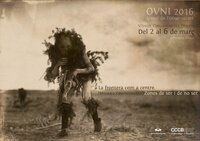
[ migra and coloniality ] / OVNI 2016
The Center as the Border. Zones of Being and not Being
/ CONTEXT 1994 - 2020
[ migra and coloniality ] / OVNI 2016
PROGRAMA CASTELLANO PDF
Videos Talks Debates.
The border has a tendency to spread: it explodes into outsourcing to third countries, and implodes as domestic borders, control devices, detentions and disappearances...; in other words, it tends to occupy the entire system, becoming centre. In the shadows of the border-as-system, where control is out of control, the prototype of a totalitarian society is assembled.
Around the subject of migration there are a series of crucial lapses or ‘forgettings’, which not only hinder in-depth reflection but also fuel exclusionary visions There first of these is the colonial lapse – we have forgotten the close ties between migration and coloniality, and its global mutation. The second lapse springs from limiting our reflections on migration to the spheres of politics, policing, economics, demographics and humanitarian action... but rarely considering it in terms of knowledge and wisdom, of which we are truly in need. A third lapse consists of labelling people “immigrants”, creating the corresponding imaginary and confining them within it... failing to remember that all of us in fact migrate between different territories, spaces, times, and forms of knowledge.
Centre de Cultura Contemporània de Barcelona
Montalegre 5. 08001 Barcelona
The shocking truth about the erosion of our fundamental civil liberties by Tony Blair's government. The Right to Protest, the Right to Freedom of Speech. The Right to Privacy. The Right not to be detained without charge, Innocent Until Proven Guilty. Prohibition from Torture. Taking Liberties will reveal how these six central pillars of liberty have been systematically destroyed by New Labour, and the freedoms of the British people stolen from under their noses amidst a climate of fear created by the media and the government itself. Irreverent but revelatory, outrageous but true, the program combines these real stories of the loss of liberty with never-before-seen footage, cheeky stunts and comment from leading politicians, celebrities, human rights organisations, academics and lawyers, which all add up to make Taking Liberties one of the most explosive and controversial films of the decade.
Untitled“Why can't you actually find a man?” Sonbol is asked by her mother. The answer is silence. Sonbol Fatemi is 35: she is attractive, single and divorced, has her own dentist surgery, likes to tell dirty jokes and has a passion for car races - competing against men. Sonbol lives in the holy city Mashad, in the Islamic Republic of Iran. Living a life like this in Iran means that she has to fight everyday. Against her mother who would love to arrange another marriage for her. Against the sports administration that wants to exclude women from rallyes altogether. And not least, against her own doubts about God and whether He is actually by her side. SONBOL gives a unique insight into a torn society by painting the portrait of an extraordinary and unconventional woman who pays a high price in order to be her self.
Life in an Immigration Detention Centre is not life at all, it is waiting. Waiting and fear. Fear of deportation, fear of losing your direction while your life is limited to the four walls of the cell, fear of a future that could surely not be worse. The testimonies of former inmates of the Immigrant Detention Centre (CIE) at Zona Franca, Barcelona, offer us a glimpse of the reality of these illegal, covert prisons.
UntitledThis documentary challenges the social bases of domestic violence by showing the strategies used by women who work in the legal system, in the gaps left where there are no longer traditions, beliefs or state or religious laws. It is an epic everyday struggle to defend women, but also to convince poor women of their rights. Sisters in Law is a fascinating look at the work of a courthouse in a small town in Cameroon, Central Africa. The tough-minded state prosecutor, Vera Ngassa and judge, Beatrice Ntuba, are helping women and children to find the courage to fight difficult cases of domestic violence and child abuse despite pressures from family and their community to remain silent. Through their emotional stories and courage, the extraordinary work of women in the judicial system shines through. With fierce compassion, the female prosecutor and judge dispense wisdom and justice in fair measure; handing down stiff sentences to those convicted. Sisters in Law presents another reality of African Women’s agency and their resilient spirit, courage, hope and fight for justice and gender equality.
UntitledSin Papeles tells the story of the of a hunger strike staged by migrant workers, without papers (sin papeles), in a small church in Barcelona by bringing together a sound recording of its climax made in March 2001 and film footage of the location shot four years later to the day. The subjective account of the event made by the artist in the form of a sub-titled narration is a process of personal reflection de-objectifying the subject of migration for the purpose of work, displacement and social order. The film is a reflection on the implications and realities of the aspects of the EU project that have created a fortress of Europe.
Practical information
A presentation of Kurdish films by the Rojava Kurdistan Film Commune (Northern Syria)
OVNI has collaborated with the Rojava Film Commune in a project aimed at researching, screening, and promoting their work in Spain, Italy, and France. A process of investigation through videos, texts, and meetings, in order to listen to their voices and understand their struggle together. We have created a website that you can visit link.
Komîna fîlm a Rojava (Rojava Film Commune) is a collective of filmmakers founded in 2015, based in the autonomous Rojava region in the Federation of Northern and Eastern Syria. The Commune is actively working in the region to rebuild and reorganise filmmaking and film education infrastructures.
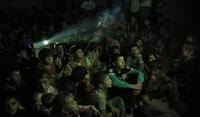
The Rojava Film Commune was established to promote local film culture by organising film screenings, facilitating discussions on the role of film within society, producing new films, and setting up a Film Academy. Following the 1960 fire in Rojava’s only cinema in the city of Amude—which saw the death of 298 children trapped inside—the Commune aims to reclaim film as a central space for reimagining society, by democratising and revolutionising the imagination itself.
The Commune has educated a new generation of Rojava filmmakers, organized screenings in cities and villages, and produced new films. It seeks to represent the values and ideals of the Rojava Revolution, but also to mediate and depict the daily struggles in the Syrian civil war and Rojava’s collective attempt to build a new society.
The Rojava Film Academy provides education for aspiring filmmakers in Northern Syria. Founded in 2015, it offers one-year programmes, with courses on international film history, Kurdish film history, film theory, photography, cinematography, script writing, editing, and sound design, taught by local and international film professionals.
The Academy is self-organized and non-hierarchical, encouraging students to participate in every aspect of its organization. Exchange networks have also been set up with other academic, media, and news platforms, and with civil society organizations, in order to engage in broad discussions and create screening possibilities. Considering the influx of foreign filmmakers and journalists to Rojava, it is important for the Commune to reclaim the representation and imagination of the revolution.
After decades of oppression of Kurdish language and culture, the Rojava Film Academy aims to revitalize local film culture, reclaiming the power to narrate and imagine one’s dreams and realities. After the Syrian Civil War started, the predominantly Kurdish northern region declared the Autonomy Administration, creating structures based on grassroots democracy, women’s liberation, and cultural diversity.
The Academy bases its methodology on ‘revolutionary realism’, i.e. a realism that does not merely reveal the current reality in a new way, but also restructures the reality of the possible . As well as finding forms to express things as-they-are, it creates the opportunity to imagine the not-yet-present, the ‘eternal becoming’ that is the revolution itself.