Colonialismo

Elements area

Taxonomy

Code

Scope note(s)

    Source note(s)

      Display note(s)

        Hierarchical terms

        Colonialismo

          Equivalent terms

          Colonialismo

            Associated terms

            Colonialismo

              7 Archival description results for Colonialismo

              7 results directly related Exclude narrower terms
              The Colonial Dream
              ES ES-OVNI CTX-S011 · Series · 2006
              Part of Non-Identified Video Observatory (OVNI)

              Autonomous Zones _ OVNI 2006

              Colonial dream - Autonomous zones Archive

              / CONTEXT 1994 - 2020

              Autonomous Zones _ OVNI 2006

              The Colonial Dream_ Autonomous Zones

              Colonialism and Eurocentrism are often discussed as though they were things of the past, fortunately overcome. But in life under globalisation, the reality seems to be just the opposite: the occupation and destruction of other worlds and cultures, systematic exploitation of their resources... and also aggressions at the local level, real-estate violence, colonial tourism, migra...

              Autonomy and no-zones: other ways of perceiving and creating community-based external realities and subjective inner ones. Autonomous ways of living and thinking, zones without limits, no-zones.

              After the OVNI 2005 program Resistances (1), we thought it was necessary to deepen the critical intent of the Observatory Archives through documents that reflect upon some of the roots of the situation we are currently living in. Many situations described in the videos that we screened can be traced back to the colonial pulse, either implicitly or explicitly. Similarly, Eurocentrism and the idea that all progress - even revolutionary progress- must pass through the European experience or take it as an unavoidable reference, are still present in conservative thought, and also, in a worrying and paradoxical way, in dissidence. We also wanted to go beyond the negativity that taking a position of resistance necessarily entails, and to show and share the communal and personal affirmations that are being produced in many societies and cultures, and all around us.

              The Colonial Dream*Autonomous Zones sets out on a search that was already implicit in the Archives under different names, an undertaking that will naturally be conditioned by our limitations in the face of such an enormous and complex subject. This first approximation that we share with you now would not have been possible without the many contributions and collaborations that we've received - help in locating particular documents and also finding a direction within the search. In any case, our aim is not to build up a collection of historical documents, or provide a catalogue of specific events, tasks that we would be unsuited for. Rather, given the nature of the Observatory Archives, we want to offer a selection that provides some of the keys and fractals of the subject. This selection is complemented by presentations from some of the people and collectives who have shared the investigation with us or are fundamental points of reference within it, such as the ContraPlano - LAD working group, Michael Taussig (Lecturer at Columbia University and author of Mimesis and Alterity, Shamanism, Colonialism and the Wild Man ...), Serra Ciliv (!f.Istanbul Festival) and René Vautier ( Afrique 50, Algeria in Flames, Hirochirac. ..).

              Our search for contemporary news and promotional materials (from 1930 to 1965) that are key to understanding how the imaginary of the time was constructed led us to some of the major audiovisual archives in the world (storehouses of the colonial legacy). Through our contact with them we came to understand the workings of something that is part of the collective memory of mankind, and how such places are managed. "Management" that is largely governed by the criteria of financial gain. Ignoring such things as non-profit, educational, etc criteria, offensive rates are applied to the extent, for example, of charging up to twenty thousand euros for screening 30 minutes of material (2). Private archives, public archives managed by private companies, or public bodies that are run according to similar criteria prevent free access, or any access, to the audiovisual material that, in this particular case, adds up to a catalogue of evidence against Europe's supposedly civilizing impulse; and a "bank" of the arguments that are still applied even now to current crises. The discovery of how difficult it is to access this material made us aware of the urgency of demanding and defending public access to these archives, which, as we said, form part of the collective memory of mankind. And to prevent the same thing happening in future with the material that is contemporary to us now.

              We don't claim objective truth for the government and corporate documents, or from those by independent authors or groups - "Film is not now nor has it ever been the technology of truth. It lies at a speed of 24 frames per second. Its value s not as a recorder of history, but simply as a means of communication, a means by which meaning is generated. The frightening aspect of the documentary film is that it can generate rigid history in the present in the same manner that Disney can generate the colonial meaning of the culture of the Other. Whenever imploded films exist simultaneously as fiction and nonfiction they stand as evidence that history is made in Hollywood" (3). In reality, what we're showing are not historical events, but images. And even then, the images can't be pared back to the documentary value of the imaginary they create, images that are real in themselves and not in relation to what they represent. "Imaginary" realities - but not any less real for it. Rather than responding to the criteria of true or false, these images respond to the who, how and for what they were imagined.

              In his 1951 film Afrique 50 against savagery, colonialism and exploitation, René Vautier breaks with the complicity of most documentaries and news reports filmed in Africa at the time, full of "greedy lies and fraudulent complacencies". In his words: "Look what lies in store for the people of Africa: we're in Palaka, in northern Ivory Coast. The village couldn't pay the colonial taxes: 3700 francs! On February 27, 1949 at 5 am the troops came, surrounded the village, fired, burned, murdered (...) On this African ground four bodies, three men and one woman, were murdered in our name. In the name of the French people! It's mind blowing: burnt houses, massacred townspeople, dead cattle rotting in the sun. Friends, colonialisation here is just like anywhere else, its run by vultures." These reflections led to 13 lawsuits, a year in jail and the film being banned in one way or another for 50 years.

              In a different way, in Les Maîtres Fous Jean Rouche shows us how there are other ways of conspiring against colonial domination, when direct confrontation isn't possible. Or in Moi, un Noir , how a group of Nigerien migrants would rather return to the "poverty" of their country than struggle to survive in the "wealth" of the colonial paradise.

              First Contact shows archival images of the first time the indigenous tribes of an area of New Guinea came into contact with white man, and contrasts these images with the situations taking place now.

              In Les Statues meurent Aussi, Alain Resnais and Chris Marker look at how difficult it is to dialogue or simply understand other countries from a Eurocentric position, and how other cultures are subjugated to the "colonial" gaze.

              The colonial imaginaries, made up of images filmed by the colonial powers as a testament to their work and their value, are also reflected in the material on the ex-Spanish colony of Equatorial Guinea that was made available to us by the Filmoteca de Catalunya and reflects the obsessions of the times: the task of Christianisation, the idyllic idea of bringing progress to new lands, the enthusiastic hunt for wild animals, the felling of trees, the militarization of life. Vincent Monnikendam also deals with these and other more complex issues in Mother Dao , one of the most enlightening and poetic visions of colonial realities, constructed entirely from images filmed by the Dutch colonisers in Indonesia.

              The spectacular directions of this vision already appear on the European continent at the end of the 19th and start of the 20th centuries, with the Colonial Exhibitions that t

              ES ES-OVNI CTX-S018 · Series · 2016
              Part of Non-Identified Video Observatory (OVNI)

              [ migra and coloniality ] / OVNI 2016

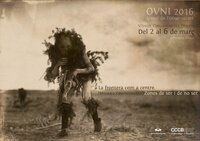
              The Center as the Border. Zones of Being and not Being

              / CONTEXT 1994 - 2020

              [ migra and coloniality ] / OVNI 2016

              PROGRAMA CASTELLANO PDF

              Videos Talks Debates.

              The border has a tendency to spread: it explodes into outsourcing to third countries, and implodes as domestic borders, control devices, detentions and disappearances...; in other words, it tends to occupy the entire system, becoming centre. In the shadows of the border-as-system, where control is out of control, the prototype of a totalitarian society is assembled.

              Around the subject of migration there are a series of crucial lapses or ‘forgettings’, which not only hinder in-depth reflection but also fuel exclusionary visions There first of these is the colonial lapse – we have forgotten the close ties between migration and coloniality, and its global mutation. The second lapse springs from limiting our reflections on migration to the spheres of politics, policing, economics, demographics and humanitarian action... but rarely considering it in terms of knowledge and wisdom, of which we are truly in need. A third lapse consists of labelling people “immigrants”, creating the corresponding imaginary and confining them within it... failing to remember that all of us in fact migrate between different territories, spaces, times, and forms of knowledge.

              Centre de Cultura Contemporània de Barcelona

              Montalegre 5. 08001 Barcelona

              Migrant Knowledge
              ES ES-OVNI DIF-S010 · Series · 2021
              Part of Non-Identified Video Observatory (OVNI)

              From 4th to 6th November

              Decolonizing Vision  - Migrant Knowledge

              To decolonize vision would be to return it, to integrate it into the body and the other senses, to integrate it into place, its forces and emptiness... to rescue it from the tyranny of the merely optical and open it up to the “other eyes” of the body and the mind, to make it whole. Also, to open up dialogue with the power of vision that the dominant culture in the West excluded or dissected until it was extinguished.

              Toni Serra *) Abu Ali

              The selection of videos presented in the Migrant Knowledge project puts forward alternative constructions of thought, analysis, and reflection concerning migrations. It does so through a plurality of views, experiences, memories, and stories that converge in a three-day program live at the Centre Civic Can Felipa, and a two-week online audio-visual menu, based on a selection of videos from the Archives OVNI – Observatory of Unidentified Video.

              In the face of an understanding of multiculturalism as a space that is predefined and negotiated by power, the institution, and violence, the “other” is partitioned and enclosed. Thus, it is increasingly urgent and necessary to come together and exchange knowledge and experiences so as to bring about a profound transformation of the notions that have shaped the globalized world. This entails a radical redefinition of the notions of time, work, culture, and of the persistence of a single model with totalitarian tendencies. To start a process of decolonization by deconstructing and transforming the notions and beliefs that have shaped our societies.

              Modern colonialism is not only a historical phenomenon, it is primarily an attitude towards life and the world. A way of looking that divides and dissects all things, a way of looking that creates and projects ”otherness”, and sees it as a space to be occupied: as territory, culture, even time, to be colonized. By its very nature it can neither understand nor put into practice an organic unity of things, or of life, let alone of economics. It perpetually needs the “other”, to the point of severing it from itself.

              The selected program of videos includes resistances from various origins and languages, which are deployed against the imposition of single, hegemonic thought. Stories that make it possible to think, to build other worlds and to discover existing ones that are often hidden by screens of ignorance and prejudice, and by stereotyped images of the “other.”

              The video selection is curated by Toni Cots. The program is organized by Jiser and the OVNI Archives, and is part of the process of reflection carried out by the Migrant Knowledge collective.

              Jiser, which means “bridge” in Arabic, is a non-profit association based in Barcelona, whose objective is to promote artistic creation and the use of art as a tool for social transformation in the Euro-Mediterranean space, by carrying out activities that promote the exchange and rapprochement between different artistic and cultural realities in the region.

              The OVNI Archives compile and document a three-decade history, from analog video to digital video in the time of ‘social’ networks. The materials contained in the Archives are the result of various thematic research projects, a whole constellation of titles with the common denominator of free expression and reflection on individual and collective fears and pleasures, coming together to build a multi-faceted vision, like thousands of small eyes that deepen and explore our world, or announce other possible ones. A research process in which the main values are heterogeneity, contradiction, and the subjectivity that the Archives spring from. In itself, they are an antidote for cloning and repetition in the era of hyper-connectivity.

              Migrant Knowledge is a group made up of activists, artists and researchers who bring their diverse experience and background to a process of critical and collective reflection on the symbolic and institutional violence that affects migrants and/or racialized people. It aims to create communal spaces that draw attention to and fight against the mechanisms that legitimize the exercise of this violence, and create narratives of resistance that support the right for people who migrate to have rights.

              This process is woven together by connecting artistic practice and reflection. It is open to a plurality of stories, and it is flexible in its path... It defends not only the exercise of critical consciousness, but also the carrying out of actions that transform situations of discrimination, racism, and inequality.

              Thursday, 4th November 18:30h - 21:00h

              VIOLENCE <> RESISTANCE

              London "I don't call it rioting, I call it an insurrection"

              BBC, 2011. UK, VO Eng 5Min.

              An interview with writer and local resident Darcus Howe on the events that took place in London in 2011. "Have some respect for an old West Indian 'negro' " "I don't call it rioting, I call it an insurrection...of the masses of the people!»

              Göran Hugo Olsson, 2014. Sweden, Denmark, Finland, USA, VO English,  85Min.

              An archive-driven documentary covering the most daring moments in the struggle for liberation in the Third World, as well as an exploration into the mechanisms of decolonization through text fragments from Frantz Fanon’s T he Wretched of the Earth .

              Friday, 5 November 18:30h - 21:00h

              Le problème algérien et l'economie française

              Jean Pierre Gambarotta, 2006. VO French. 5Min.

              A French government report explaining the reasons why it was impossible to accept Algeria’s independence.

              Pierre-Yves Vandeweed 2011.Belgium, Western Sahara. VO Arab, 74Min.

              Drawing from stories of flight, exile, interminable waiting and arrest, and persecuted lives on both sides of the wall that divides the Western Sahara, Territoire perdu bears witness to the Sahrawi people, their land and their entrapment in other people’s dreams. The film juxtaposes sonorous landscapes, black-and-white portraits and nomadic poetics.

              Session in collaboration with the Barcelona Independent Film Festival, l'Alternativa.

              Lettre à la Republique

              in Limbo
              ES ES-OVNI CTX-S016 · Series · 2014
              Part of Non-Identified Video Observatory (OVNI)

              falling and flying / OVNI 2014

              / CONTEXT 1994 - 2020

              falling and flying / OVNI 2014

              Limbo (Lat. Limbus) ~ the world between the living and the dead ~ the storage space where deleted files are sent ~ a tale by Aldous Huxley.

              There is an enormous, constant, and well-organised pressure on social rights and freedoms, backed by a media apparatus that appropriates language and steals our words. Meanwhile, nature is still the source from which we extract the fuel that feeds the engines of progress for the few.

              Borders spill beyond boundaries and permeate cities like the laboratory for a new totalitarian society.

              Fall & Winter, Cómo robar la vida a un ser humano, Terrorisme d'Auteur, Barcelona the Dead City, Deleuze à Vincennes, Marinaleda, iPhone China, Detroit Wildlife, Barcelona panAfrica, Agustín García Calvo at Sol, Homeland Security.

              Thematical screenings

              Hall and Auditorium. Simultaneous Screenings

              Centre de Cultura Contemporània de Barcelona

              Montalegre 5. 08001 Barcelona

              Image: Pour Auguste (2010). Chantal Michel

              Exodus
              ES ES-OVNI CTX-S012 · Series · 2008
              Part of Non-Identified Video Observatory (OVNI)

              The Margins of the Empire _ OVNI 2008

              / CONTEXT 1994 - 2020

              The Margins of the Empire _ OVNI 2008

              "Open your eyes and look within. Are you satisfied with the life you're living? (...) So we gonna walk, alright, through the roads of creation. We're the generation (Tell my why) trod through great tribulation". Exodus Bob Marley

              The videos screened at OVNI 2008 will offer an initial reflection on the “marginal” and the desire to cross margins, on forms of personal or collective exodus – whether physical or as a state of mind. They include perspectives on different forms of marginalization and exploitation which lie directly under the oppressive vertical force of power, such as workers in Chinese export factories or clandestine Palestinian day workers in Israel. And perspectives on armed conflict zones that go beyond the “propaganda-counter propaganda” dialectic: in South America, Chechnya, Lebanon, Iraq, Darfur, Afghanistan...

              But they also include reflections and perspectives on other realities and forms of organization that grow on the margins: self-organization of the homeless, indigenous communities in Ecuador and Columbia, brotherhoods of transvestites in India, ancient heterodox traditions and their rituals, self-managed collectives in Barcelona, groups of deserters in the US... Together with accounts of dreams and the inner revolution, of seeking and of exodus... These are videos that question and consider this attraction towards exodus, the desire to abandon a reality and a set of values that we can no longer believe in, or wish for. Perspectives that refuse to remain trapped in an eternal “against” stance and use resistance tactically, but embark on a journey to other possible worlds. Exodus itself is another world, functionally unmappable, because exodus is always on the side of emptiness and movement, of listening to voices of the others (?) and recognising oneself in them. What gets left behind are societies swing between an abundance of poverty – made visible and turned into spectacle by the media – and the increasingly obvious misery of abundance, the misery of consumer societies.

              Let's allow fragments of transcriptions from some of the videos that will be projected talk to us about the journey:

              “A society that is always sicker, but always stronger, has everywhere concretely re-created the world as the environment and decor of its illness, a sick planet. A society that still hasn't become homogenous and that isn't determined by itself, but is always more determined by a part of itself that places itself above the rest and is exterior to it, has developed a movement that dominates natures but isn't itself dominated. (...) The production of non-life has more and more pursued its linear and cumulative process; overcoming a final threshold in its progress, it now directly produces death”. (1)

              “The consumer society has destroyed the environment. Exterminated millions of species of plants and animals. Poisoned the seas, the rivers and the lakes. Polluted the air. Filled the atmosphere with carbon dioxide and other harmful gases. Destroyed the ozone layer. Exhausted our oil, coal and gas reserves and rich mineral resources. Exterminated our forests and destroyed their own. So what is left for us? Underdevelopment. Poverty. Dependence. Underdevelopment. Debt. Uncertainty. For the super developed societies the problem is not growth but distribution. Not only amongst themselves but amongst everybody. Sustainable development is impossible without fairer distribution amongst all nations. After all, mankind is one great family all sharing the same destiny”. (2)

              “Today's ideal is consumerism. It is a homologating civilisation that makes everything the same. Without ideology? What, it has no ideology? With a consumer ideology you don't... instead of having a flag, the clothes they wear are their flag. Some of the means and some of the external phenomena have changed but, in practice, it's a depauperation of individuality which is disguised through its valorisation (...) During the so-called “repressive” ages sex was a joy, because it was practiced in secret and it made a mockery of all the obligations and duties that the repressive power imposed. (...) And so, at a certain point, one of the characters in the films says exactly this: “Repressive societies repress everything... therefore, men can't do anything.” But I have added this concept which for me is lapidary: permissive societies permit a few things and only those things can me done. Hey! That is terrible! A degree of bestowed freedom that later becomes compulsory. As it is bestowed it becomes compulsory.

              Sadomasochism is an eternal category of man: it was there in De Sade's time, it's here today, etc. But this is not what I care about. I also care about this, but the real sense of sex in my films is a metaphor of the relation between power and its subject. Therefore, in reality, it is true for all times. The drive came from the fact that I detest, above all things, today's power. Everyone hates the power he is subject to. Therefore, I hate the power of today, of 1975, with particular vehemence. It is a power that manipulates bodies in a horrible way, it has nothing to envy Himmler's or Hitler's manipulation. It manipulates them, transforming their conscience, in the worst way, establishing new values which are alienating and false. The values of consumerism, which accomplish what Marx called genocide of the living, real, previous cultures.

              In reality, the producers force the consumers to eat shit. Knapp bouillon or... They give adulterated, bad things, little Robiola cheeses, processed cheese for babies,... all horrible things that are shit (...)

              Power remains exactly the same, only its characteristics change, the subject is no longer parsimonious or religious, he is a consumer and so he is short-sighted, irreligious, secular, etc. The cultural characteristics change, but the relationship is identical. Therefore, it (Salò) is a film not only about power, but about what I call “the anarchy of power”. Nothing is more anarchic than power. Power does what it wants and what it wants is totally arbitrary or dictated by its economic reasons which escape common logic.

              My real vision, the older, more archaic one given to me at birth and shaped in my early childhood, my original way of seeing is a sacred vision of things. In the end, I see the world like those who have a poetic vocation do, that is, like a miraculous, almost sacred fact. And nothing can desecrate my fundamental sacredness”. (3)

              Constant work, constant consumption

              “... We are terrorized into being consumers. We can choose between brand A, brand B or C, that's the freedom we have. Yes, I think there are too many things. Constant work and consumption, it's crazy. This is what's destroying everything, and it has to go. I can see very little worth preserving. I don't see any benefit or wellbeing in preserving this system. Achieving all these things is actually coercion. People are forced to work in mines and packaging factories. Without them we don't have all this. A world of things, which we have to spend our whole lives fighting for. I don't think anybody really takes it seriously, but inertia keeps it moving. This has to be stopped, it has to be destroyed (...)

              Why do people go out and try to protest or try to do something? That's not violence. Sitting there doing dope and watching MTV. Then you go and get a job. Just schlep along. To me that is violence.

              It is necessary to damage or destroy property, it lies outside political confines o the politics of the everyday. What do you achieve by holding a sign at the usual demonstration? I've seen the same thing for decades, it doesn't achieve anything! But when people fight, that’s something else. They capture people’s attention, it’s real. Corporate property is the most obvious legitimate target in my view. Banks, e

              ES ES-OVNI CTX-S017 · Series · 2015
              Part of Non-Identified Video Observatory (OVNI)

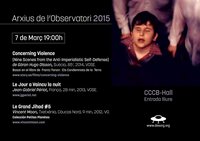
              Concerning Violence / Le Grand Jihad / Le Jour a Vaincu la Nuit

              / CONTEXT 1994 - 2020

              Observatory Archives 2015

              March 7th 2015 19:00h

              OVNI opens up public access to the Intranet of the Observatory Archives, founded in 1993. To launch this new phase, we will screen a programme of videos that establish the two poles of this project, which span from social critique at one end, to personal exploration at the other. Concerning Violence by Göran Hugo Olsson with texts by Frantz Fanon, Le Grand Jihad by Vincent Moon , a ritual around memory, and Le Jour a Vaincu la nuit, by Jean-Gabriel Périot, another around dreams.

              OVNI Archives Intranet.

              OVNI opens up public access to the Intranet of the Observatory Archives, founded in 1993, at the CCCB. The collective behind OVNI considers that audiovisual creation (video art, documentary, and media archaeology) is more than just a creative, innovative, and aesthetic discourse... it is the most contemporary and non-elitist reflection on today’s culture and society.

              It is a collective visual thinking that reflects social, personal, poetic and political realities... flowing smoothly from reality to fiction. And its specificity makes it both a device for the construction of imaginaries and a tool for deconstruction.

              In The Society of the Spectacle, Guy Debord wrote that when reality is captured and turned into mere images, these images become reality: a mechanism that consolidates the unreal core of our reality. It seem to us then, as a counterpoint, that reality itself is at stake in the creation and dissemination of images. This is why it is necessary to develop an independent audiovisual discourse: independent of commissioning dynamics, independent in regard to the choice of subject matter and the approach, and above all independent of the prefabricated norms and grammars of the audiovisual industry and its consumption and production criteria. This entails a differential defence of the perception of reality. The mechanisms of cloning and the monoform (Peter Watkins) are countered by a rhizome of unique approaches, overlapping coincidences and disparities that do not exclude contradiction, but instead value it as the presence of reality in the images.

              Fortunately, the same market logic that flooded the landscape with banal images and with devices for recording, editing, and spreading images has also enabled the democratisation of access to the means of production and has broken the audiovisual oligopoly, downplaying the importance of the big mainstream channels.

              However, we need to take advantage of this window of possibility, which may remain open for a shorter time than we imagine. He have to go beyond the fog of compulsive images that flood the networks, and pierce the veil of media images, the master copy of the film that aims to reduce reality to the order of representation, and individuals to a handful of stereotypes.

              This process of audiovisual dissidence and resistance has been, and remains, fundamental. The mirror of representation has shattered into thousands of fragments: pieces that are deep cuts in reality and at the same time reflections of it.

              We suddenly enter a complex rhizome (Deleuze_Guattari) of stories that reflect plural reality. A discourse in which the principal values are heterogeneity, contradiction, and subjectivity. An antidote to the cloning and repetition of the corporate mass media. In this rhizome made up of disparate visions, the vision that the mass media presents as objective reality is deconstructed, and revealed as the subjective imaginary of the dominant discourse.

              We could say that there is a conflict of imaginaries. On one side, the omnipresent, formidable machine for the production and dissemination of prefabricated messages, creating a range of versions based on the same basic pattern as any other consumer product: to maximise profits and ensure its own continuity. On the other side, a kind of artisan patchwork of personal or collective experiences, a patchwork that has been torn in places and is full of life.

              Fragment of the article-interview on OVNI by the magazine:

              Intertartive [a platform for contemporary art and thought]. Herman Bashiron

               http://interartive.org/2011/04/ovni/

              “In an age where show business – too often mistaken for the world of culture - has become a model for real life, where fiction and reality melt into the one solution, and where physical and mental solidity dissolve into a continuous flow of images and appearances, here, in this intricate and complex mutation of reality, the work of OVNI offers an antidote to the poisons of contemporary information and communication. For over twenty years, it has been a “Temporary Autonomous Zone” – as Hakim Bey, collaborator of one of the editions of OVNI, would say –, presenting an intense programme of video art, independent documentary and mass media archaeology at the CCCB in Barcelona and beyond. The in-depth research carried out by OVNI clearly shows how independent audiovisual productions are gaining increasing visibility and international recognition and, at the same time, they are devices that are highly critical of contemporary culture and society."

              The Intranet Archives.

              The launch of this Intranet of the OVNI Archives at the CCCB makes approximately 2000 audiovisual works – the entire holdings of the Archives – available to the public. A collection of works that we will continue to build on with new acquisition, as in the case of the works screened at the launch, which will be incorporated into the archive.

              The Observatory Archives: A tool.

              Over the last few years, various developments have forced us to review our project, leading us to closely examine the real characteristics and functionalities of other parallel projects: how they work and how they are used.

              It is necessary to think critically about what archives are, and about the value of an archive. This is the case now more than ever, against the backdrop of the compulsive creation of numerous Archives over the past ten years, most of which are based on accumulative criteria: either the accumulation of existing dominant values (a "who's who" of a particular audiovisual scene) or simply a quantitative accumulation. In contrast, the OVNI Archives are the result of specific reflection on a continuum of themes that have been crucial in recent decades; a reflection that has been woven into the works themselves, in a kind of meta search. We could say that they are archives with a thesis; they have gone against the flow of dominant thinking and fads.

              At the same time, there is only limited value in archives that can be consulted but are isolated and fossilised. Archives become valuable when they can be read, when they can create meanings, suggest transversal readings and intersections. Being accessible to the public is one condition that allows this, but it does not guarantee or facilitate it. It is the knowledge generated by the Archives, and above all, the knowledge that has been generated through them, that makes it possible to make the most out of them: as a base from which to organise workshops, debates, specific programmes... This is the project that we are working on; the launch of this Intranet is only the first step.