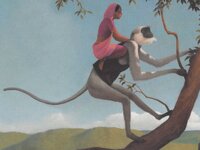
The Margins of the Empire _ OVNI 2008
/ CONTEXT 1994 - 2020
The Margins of the Empire _ OVNI 2008
"Open your eyes and look within. Are you satisfied with the life you're living? (...) So we gonna walk, alright, through the roads of creation. We're the generation (Tell my why) trod through great tribulation". Exodus Bob Marley
The videos screened at OVNI 2008 will offer an initial reflection on the “marginal” and the desire to cross margins, on forms of personal or collective exodus – whether physical or as a state of mind. They include perspectives on different forms of marginalization and exploitation which lie directly under the oppressive vertical force of power, such as workers in Chinese export factories or clandestine Palestinian day workers in Israel. And perspectives on armed conflict zones that go beyond the “propaganda-counter propaganda” dialectic: in South America, Chechnya, Lebanon, Iraq, Darfur, Afghanistan...
But they also include reflections and perspectives on other realities and forms of organization that grow on the margins: self-organization of the homeless, indigenous communities in Ecuador and Columbia, brotherhoods of transvestites in India, ancient heterodox traditions and their rituals, self-managed collectives in Barcelona, groups of deserters in the US... Together with accounts of dreams and the inner revolution, of seeking and of exodus... These are videos that question and consider this attraction towards exodus, the desire to abandon a reality and a set of values that we can no longer believe in, or wish for. Perspectives that refuse to remain trapped in an eternal “against” stance and use resistance tactically, but embark on a journey to other possible worlds. Exodus itself is another world, functionally unmappable, because exodus is always on the side of emptiness and movement, of listening to voices of the others (?) and recognising oneself in them. What gets left behind are societies swing between an abundance of poverty – made visible and turned into spectacle by the media – and the increasingly obvious misery of abundance, the misery of consumer societies.
Let's allow fragments of transcriptions from some of the videos that will be projected talk to us about the journey:
“A society that is always sicker, but always stronger, has everywhere concretely re-created the world as the environment and decor of its illness, a sick planet. A society that still hasn't become homogenous and that isn't determined by itself, but is always more determined by a part of itself that places itself above the rest and is exterior to it, has developed a movement that dominates natures but isn't itself dominated. (...) The production of non-life has more and more pursued its linear and cumulative process; overcoming a final threshold in its progress, it now directly produces death”. (1)
“The consumer society has destroyed the environment. Exterminated millions of species of plants and animals. Poisoned the seas, the rivers and the lakes. Polluted the air. Filled the atmosphere with carbon dioxide and other harmful gases. Destroyed the ozone layer. Exhausted our oil, coal and gas reserves and rich mineral resources. Exterminated our forests and destroyed their own. So what is left for us? Underdevelopment. Poverty. Dependence. Underdevelopment. Debt. Uncertainty. For the super developed societies the problem is not growth but distribution. Not only amongst themselves but amongst everybody. Sustainable development is impossible without fairer distribution amongst all nations. After all, mankind is one great family all sharing the same destiny”. (2)
“Today's ideal is consumerism. It is a homologating civilisation that makes everything the same. Without ideology? What, it has no ideology? With a consumer ideology you don't... instead of having a flag, the clothes they wear are their flag. Some of the means and some of the external phenomena have changed but, in practice, it's a depauperation of individuality which is disguised through its valorisation (...) During the so-called “repressive” ages sex was a joy, because it was practiced in secret and it made a mockery of all the obligations and duties that the repressive power imposed. (...) And so, at a certain point, one of the characters in the films says exactly this: “Repressive societies repress everything... therefore, men can't do anything.” But I have added this concept which for me is lapidary: permissive societies permit a few things and only those things can me done. Hey! That is terrible! A degree of bestowed freedom that later becomes compulsory. As it is bestowed it becomes compulsory.
Sadomasochism is an eternal category of man: it was there in De Sade's time, it's here today, etc. But this is not what I care about. I also care about this, but the real sense of sex in my films is a metaphor of the relation between power and its subject. Therefore, in reality, it is true for all times. The drive came from the fact that I detest, above all things, today's power. Everyone hates the power he is subject to. Therefore, I hate the power of today, of 1975, with particular vehemence. It is a power that manipulates bodies in a horrible way, it has nothing to envy Himmler's or Hitler's manipulation. It manipulates them, transforming their conscience, in the worst way, establishing new values which are alienating and false. The values of consumerism, which accomplish what Marx called genocide of the living, real, previous cultures.
In reality, the producers force the consumers to eat shit. Knapp bouillon or... They give adulterated, bad things, little Robiola cheeses, processed cheese for babies,... all horrible things that are shit (...)
Power remains exactly the same, only its characteristics change, the subject is no longer parsimonious or religious, he is a consumer and so he is short-sighted, irreligious, secular, etc. The cultural characteristics change, but the relationship is identical. Therefore, it (Salò) is a film not only about power, but about what I call “the anarchy of power”. Nothing is more anarchic than power. Power does what it wants and what it wants is totally arbitrary or dictated by its economic reasons which escape common logic.
My real vision, the older, more archaic one given to me at birth and shaped in my early childhood, my original way of seeing is a sacred vision of things. In the end, I see the world like those who have a poetic vocation do, that is, like a miraculous, almost sacred fact. And nothing can desecrate my fundamental sacredness”. (3)
Constant work, constant consumption
“... We are terrorized into being consumers. We can choose between brand A, brand B or C, that's the freedom we have. Yes, I think there are too many things. Constant work and consumption, it's crazy. This is what's destroying everything, and it has to go. I can see very little worth preserving. I don't see any benefit or wellbeing in preserving this system. Achieving all these things is actually coercion. People are forced to work in mines and packaging factories. Without them we don't have all this. A world of things, which we have to spend our whole lives fighting for. I don't think anybody really takes it seriously, but inertia keeps it moving. This has to be stopped, it has to be destroyed (...)
Why do people go out and try to protest or try to do something? That's not violence. Sitting there doing dope and watching MTV. Then you go and get a job. Just schlep along. To me that is violence.
It is necessary to damage or destroy property, it lies outside political confines o the politics of the everyday. What do you achieve by holding a sign at the usual demonstration? I've seen the same thing for decades, it doesn't achieve anything! But when people fight, that’s something else. They capture people’s attention, it’s real. Corporate property is the most obvious legitimate target in my view. Banks, e