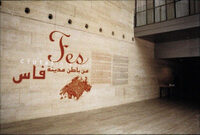
An initiatic journey Videos from an exhibition at the Centre de Cultura Comtemporània de Barcelona from March 26 to May 30, 2002 (a project by Albert Garcia-Espuche and Toni Serra). Into the innermost parts of the city of Fes.Using audiovisual recordings that illustrate some of the different anthropologic, sociologic, urbanistic and religious aspects that make up the fabric of the city. A journey that requires both objectivity (in the working method) and subjectivity (for the experience of the journey and immersion in another culture).
Colonialismo
115 Archival description results for Colonialismo
Happy Birthday to the National Front! For a long time, driven by the need to establish a dialogue around the Algerian War, René Vautier recorded the testimonies of Algerian independence activists, French conscripts and reservists, generals of the French army, historians... Thus, Mohamed Moulay, Ali Rouchaï, Mohamed Loulli, Germaine Tillion, Paul Teitgen, Pierre Vidal-Naquet, Colonel Antoine Argoud, General de Bollardière, and General Jacques Massu, among others, gave their testimony before Vautier’s camera. A documentary long unseen that reminds us where the National Front comes from, which changed its name and gained some respectability after Jean-Marie Le Pen’s leadership. Warning: The film is a rescued copy. The technical quality is degraded, but that is only a detail... The Man with Bloody Hands (by René Vautier) I had embarked on a historical project: recording on video tapes the “memories” of witnesses of the Algerian War, so that one day young students from France and Algeria could write together, in images, a common history of the relations between the two peoples. I was told about a man, in Saint-Eugène, who, despite having been tortured, had trouble asserting his pension rights because he had never been a member of the FLN. I interviewed him somewhat by chance: he told me about his tortures, and how, between sessions of “gégène” (electric torture) and “bathtub” (immersion torture), his torturers had pushed his thumbs into his eye sockets: “as if they wanted to make my eyes pop out.” Then I did what I always did: showed him a series of photos of paratrooper officers, to ask if he recognized his torturers. Very dignifiedly, he told me he could no longer see... but he added: “I have a paper from Mr. Mayor (the mayor of Algiers at the time was Jacques Chevalier, former Minister of Defense under Mendès-France) where the name of the paratrooper lieutenant is written.” That’s how I saw that the name he couldn’t read — he had gone blind due to the tortures — was that of Lieutenant Le Pen. I had Jacques Chevalier’s signature authenticated by his family members and people who had worked with him; I checked documents from the time — there was no doubt. Apparently, there is a law in France forbidding the use of testimonies about atrocities committed during the Algerian War. Let’s not be ridiculous: Austrians are suspected of putting at the head of their republic a man accused of having “covered up” tortures, and yet we should hide from the French documents that the whole world will feast on during the presidential elections? Because no law can prevent the whole world — except France! — from knowing that we will have a candidate not only with delirious statements but with bloody hands. This article was published in L’Humanité on September 29, 1987.
A thirty minute documentary that captures the actions of the Caracas peoples' movements that pulled down the detested statue of Christopher Columbus (Cristobal COLÓN in Spanish) in Plaza Venezuela on the 12th of October 2005. Through its simplicity, this small but historic event opened up new paths in the anti-COLONial subjectivity of the people by provoking a controversy that led to complex debate. Their action opened up thousands of discussions, not just about the depth of the COLONial aculturalisation that we have been subject to as peoples, but also about the danger that the Bolivarian Revolution be used as an alibi by the bureaucratic processes that deny the people their collective and sovereign power to act. This documentary gives voice to the people's struggle for autonomy and continental rebellion that has been gestating for centuries in the belly of Pachamerika.
UntitledQueen Elizabeth pays homage to Cecil Rhodes on her tour of Africa. Tribes pay tribute to Queen Elizabeth.
An anticolonial film about colonial repression on the Ivory coast. A virulent attack on the French colonial system after the second world war that has been banned in France for half a century.
"Here, the village chief, Sikali Wattara, was smoked out and shot in the back of the neck, a French bullet... Here, a seven-month-old child was killed, a French bullet blew her skull off... Here, blood on the wall, a pregnant woman came to die, two French bullets in her belly... On this African soil, four corpses, three men and a woman murdered in the name of us, people of France!" So spoke René Vautier on his first images as a filmmaker, shot clandestinely in 1949 across colonial Africa and saved in extremis from censorship. Banned for 40 years, the film was rehabilitated in 1990 by the French Ministry of Foreign Affairs, which showed it in embassies in Africa to prove that French anti-colonial sentiment did indeed exist in the early 50s...
This video documents the extent of the environmental impact provoked by the activities of an oil company in the Equatorial Amazon. Oil-related activity in the indigenous communities of north-east Ecuador has had a very serious social impact. Since the 1960s, various companies have been damaging the ecosystems of indigenous communities who live in shelters, supposedly protected by the state, while they are affected by disease and their internal relationships gradually break down.
Interview with historian Jacques Choukroun (bonus material from the DVD René Vautier in Algeria), focusing on the role of independent Algeria in Africa during the 1960s, as well as René Vautier's presence in post-independence Algeria — “the loudspeaker of peoples in struggle,” as the Breton filmmaker with the red camera was called. The discussion touches on: the Bandung Conference, the historic newspaper Révolution Africaine, pan-Africanism, Bouteflika’s role, and the 1965 coup d’état.
At the dawn of the Algerian independence struggle, René Vautier produced a film about the French conquest of Algeria in 1830. It was severely criticized by the French Ministry of Foreign Affairs, which regarded this prediction of an Algerian rebellion against the foreign oppressor as a danger to national security. In reaction to this accusation, in 1957 René Vautier went over to the "other side" and shot, camera in hand, a film about and with the Algerian resistance movement. René Vautier wanted to show what he saw and counter the French colonial propaganda version. Naturally, the French side sought him out for what they considered to be treason. Nevertheless, 800 copies of the film were printed from East Germany, in 17 languages, and distributed worldwide (except in France, where it had to wait for a screening at the occupied Sorbonne in May 68). But not all Algerian independence fighters agreed that their revolution should be filmed by a Frenchman, especially as René Vautier's contact had been liquidated. Caught up in the meanders of revolutionary power struggles, and without being told why, the filmmaker is detained in a prison by decision of the Provisional Government of the Algerian Republic (GPRA) along with other Algerians, while the film is broadcast by the FLN... Twenty-five months in a prison in Denden, west of Tunis. After the declaration of independence, René Vautier founded the first Algerian Audiovisual Center and directed the first film in independent Algeria: Le peuple en marche. During this shoot, René Vautier was wounded three times. He came under direct fire from the French army, deliberately aimed at his camera. A piece of shrapnel lodged in the Breton filmmaker's (hard) head. He would carry this memory with him all his life, making him probably the only filmmaker with a piece of camera in his head.
1992, Algeria plunges into violence. Thanks to various unpublished archives, this document offers another vision power, opposition and the heart of Algerian society.
Untitled