
Happy Birthday to the National Front! For a long time, driven by the need to establish a dialogue around the Algerian War, René Vautier recorded the testimonies of Algerian independence activists, French conscripts and reservists, generals of the French army, historians... Thus, Mohamed Moulay, Ali Rouchaï, Mohamed Loulli, Germaine Tillion, Paul Teitgen, Pierre Vidal-Naquet, Colonel Antoine Argoud, General de Bollardière, and General Jacques Massu, among others, gave their testimony before Vautier’s camera. A documentary long unseen that reminds us where the National Front comes from, which changed its name and gained some respectability after Jean-Marie Le Pen’s leadership. Warning: The film is a rescued copy. The technical quality is degraded, but that is only a detail... The Man with Bloody Hands (by René Vautier) I had embarked on a historical project: recording on video tapes the “memories” of witnesses of the Algerian War, so that one day young students from France and Algeria could write together, in images, a common history of the relations between the two peoples. I was told about a man, in Saint-Eugène, who, despite having been tortured, had trouble asserting his pension rights because he had never been a member of the FLN. I interviewed him somewhat by chance: he told me about his tortures, and how, between sessions of “gégène” (electric torture) and “bathtub” (immersion torture), his torturers had pushed his thumbs into his eye sockets: “as if they wanted to make my eyes pop out.” Then I did what I always did: showed him a series of photos of paratrooper officers, to ask if he recognized his torturers. Very dignifiedly, he told me he could no longer see... but he added: “I have a paper from Mr. Mayor (the mayor of Algiers at the time was Jacques Chevalier, former Minister of Defense under Mendès-France) where the name of the paratrooper lieutenant is written.” That’s how I saw that the name he couldn’t read — he had gone blind due to the tortures — was that of Lieutenant Le Pen. I had Jacques Chevalier’s signature authenticated by his family members and people who had worked with him; I checked documents from the time — there was no doubt. Apparently, there is a law in France forbidding the use of testimonies about atrocities committed during the Algerian War. Let’s not be ridiculous: Austrians are suspected of putting at the head of their republic a man accused of having “covered up” tortures, and yet we should hide from the French documents that the whole world will feast on during the presidential elections? Because no law can prevent the whole world — except France! — from knowing that we will have a candidate not only with delirious statements but with bloody hands. This article was published in L’Humanité on September 29, 1987.
Africa
62 Archival description results for Africa
62 results directly related
Exclude narrower terms
ES ES-OVNI RSC-4356
·
Item
·
1988
Part of Non-Identified Video Observatory (OVNI)

ES ES-OVNI CTX-S011-SS004-0013
·
Item
·
1950
Part of Non-Identified Video Observatory (OVNI)
An anticolonial film about colonial repression on the Ivory coast. A virulent attack on the French colonial system after the second world war that has been banned in France for half a century.
ES ES-OVNI RSC-4338
·
Item
·
1950
Part of Non-Identified Video Observatory (OVNI)
"Here, the village chief, Sikali Wattara, was smoked out and shot in the back of the neck, a French bullet... Here, a seven-month-old child was killed, a French bullet blew her skull off... Here, blood on the wall, a pregnant woman came to die, two French bullets in her belly... On this African soil, four corpses, three men and a woman murdered in the name of us, people of France!" So spoke René Vautier on his first images as a filmmaker, shot clandestinely in 1949 across colonial Africa and saved in extremis from censorship. Banned for 40 years, the film was rehabilitated in 1990 by the French Ministry of Foreign Affairs, which showed it in embassies in Africa to prove that French anti-colonial sentiment did indeed exist in the early 50s...
ES ES-OVNI RSC-4355
·
Item
·
2014
Part of Non-Identified Video Observatory (OVNI)
Interview with historian Jacques Choukroun (bonus material from the DVD René Vautier in Algeria), focusing on the role of independent Algeria in Africa during the 1960s, as well as René Vautier's presence in post-independence Algeria — “the loudspeaker of peoples in struggle,” as the Breton filmmaker with the red camera was called. The discussion touches on: the Bandung Conference, the historic newspaper Révolution Africaine, pan-Africanism, Bouteflika’s role, and the 1965 coup d’état.
ES ES-OVNI RSC-4340
·
Item
·
1958
Part of Non-Identified Video Observatory (OVNI)
At the dawn of the Algerian independence struggle, René Vautier produced a film about the French conquest of Algeria in 1830. It was severely criticized by the French Ministry of Foreign Affairs, which regarded this prediction of an Algerian rebellion against the foreign oppressor as a danger to national security. In reaction to this accusation, in 1957 René Vautier went over to the "other side" and shot, camera in hand, a film about and with the Algerian resistance movement. René Vautier wanted to show what he saw and counter the French colonial propaganda version. Naturally, the French side sought him out for what they considered to be treason. Nevertheless, 800 copies of the film were printed from East Germany, in 17 languages, and distributed worldwide (except in France, where it had to wait for a screening at the occupied Sorbonne in May 68). But not all Algerian independence fighters agreed that their revolution should be filmed by a Frenchman, especially as René Vautier's contact had been liquidated. Caught up in the meanders of revolutionary power struggles, and without being told why, the filmmaker is detained in a prison by decision of the Provisional Government of the Algerian Republic (GPRA) along with other Algerians, while the film is broadcast by the FLN... Twenty-five months in a prison in Denden, west of Tunis. After the declaration of independence, René Vautier founded the first Algerian Audiovisual Center and directed the first film in independent Algeria: Le peuple en marche. During this shoot, René Vautier was wounded three times. He came under direct fire from the French army, deliberately aimed at his camera. A piece of shrapnel lodged in the Breton filmmaker's (hard) head. He would carry this memory with him all his life, making him probably the only filmmaker with a piece of camera in his head.
ES ES-OVNI CTX-S013-SS007-0079
·
Item
·
2002
Part of Non-Identified Video Observatory (OVNI)
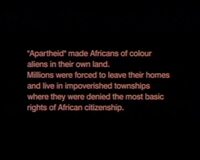
Amandla! is an impassioned chronicle of the role of music as a mean of protest and survival through more than 40 years of struggle against racial oppression. “The apartheid government took everything away from people, but it couldn't stop them from singing”, says director Lee Hirsch. In the songs there could even be found a rare ability of South Africa's people to find humour and creativity in impossible conditions, in abject poverty - and in battle.
Untitled
ES ES-OVNI CTX-S012-SS007-0105
·
Item
·
2006
Part of Non-Identified Video Observatory (OVNI)
A film-document that explores the foundations of new colonialism on Africa. A searing indictment of World Bank monetary policies of forced eviction and exclusion. The story takes place in a poor quarter of Bamako and features a fictitious mock-trial with the participation of many people who “legally” challenge the World Bank.
Untitled
ES ES-OVNI CTX-S014-SS001-0047
·
Item
·
1939
Part of Non-Identified Video Observatory (OVNI)
Brazza deals with the history of the exploration of what would eventually become French Equatorial Africa. Robert Darène is perfect in the role of a lay missionary, a barefoot idealist, French by choice rather than birth, who is determined to spread the Republican gospel of civilisation, abolish slavery, and confront the world of ruffians (the already-rich Anglo Saxons). The story is told by another idealist, Léon Poirier, proud of his sobriquet "The African." A story with so much candour that it may make viewers smile sceptically, or even become outright angry. It is therefore essential to pay attention to the powerful, scathing analysis by Eric Deroo, an expert on colonial history. And the witty and sometimes indignant analysis of the film by two Batékés, who nonetheless admit to feeling a measure of respect for Brazza.
Untitled
ES ES-OVNI CTX-S012-SS006-0003
·
Item
·
2005
Part of Non-Identified Video Observatory (OVNI)
"In 1996, I was staying in the village of Mankien in South Sudan to film the war which was taking place. At the time, I thought that making a film about an area struggling with such a severe conflict would almost have to be an act of duty. Once there, the reality appeared completely different from what I initially imagined it would be. The war that was all around me was not only a struggle between an oppressive government and a downtrodden minority but a latent conflict driven by power and economic interests. Back in Belgium, I felt overwhelmed by a strong feeling of helplessness and disillusionment to the point of never showing these images, up to now. A short while ago, I was told that the village of Mankien had been subjected to a massacre orchestrated by the Khartoum government with more than the slight complicity of Western oil companies. Closed District is not only a film about the war in South Sudan, but more about wars in general, about the death and distress that often ensues. It also raises the question of the filmmaker's place in a situation of conflict". (Pierre-Yves Vandeweerd)
Untitled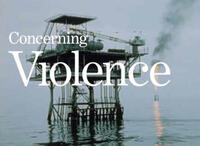
ES ES-OVNI CTX-S017-SS001-0001
·
Item
·
2014
Part of Non-Identified Video Observatory (OVNI)
A film by Göran Hugo Olsson Based on Frantz Fanon’s The Wretched of the Earth Narrated by Ms. Lauryn Hill Preface by Gayatri Chakravorty Spivak Including appearances by Thomas Sankara Amílcar Cabral Tonderai Makoni Robert Mugabe FRELIMO MPLA. Concerning Violence is both an archive-driven documentary covering the most daring moments in the struggle for liberation in the Third World, as well as an exploration into the mechanisms of decolonization through text from Frantz Fanon’s The Wretched of the Earth. Fanon’s landmark book, written over 50 years ago, is still a major tool for understanding and illuminating the neocolonialism happening today, as well as the violence and reactions against it. In the middle of the Cold War, radical Swedish filmmakers set out to capture the anti-imperialist liberation movements in Africa first hand. With their 16mm footage, found in the Swedish Television archives, filmmaker Göran Hugo Olsson draws on his experience making The Black Power Mixtape (2011) to create a visual narrative from Africa - images of the pursuit of freedom, the Cold War and Sweden. Swedish filmmakers, with their sense of solidarity with anti-imperial and socialist struggles around the world at the time, created images and stories which still resonate today, and can change and deepen our impression of the globalized world we live in. The people captured by these filmmakers fought with their lives at stake, for their and others’ freedom. The unique archival footage features a nighttime raid with the MPLA in Angola, interviews with the guerrilla soldiers of FRELIMO in Mozambique, as well as with Thomas Sankara, Amílcar Cabral and other African revolutionaries. The imagery is fantastic: clear, crisp and unique films that convey a sense of urgency and dedication that was at the heart of the decolonization movements. ”National liberation, national renaissance, the restoration of nationhood to the people: whatever may be the headings used or the new formulas introduced, decolonization is always a violent phenomenon.” In pictures and interviews, as well as with a narrating voice guiding the audience through the material with the words of Frantz Fanon. Concerning Violence tells the story of the people and ideas behind one of the most urgent struggles for freedom and change in the 20th century. The organization of the film into nine chapters connects quite abstract ideas with concrete images and real people who embody and carry the story. Crafting a form that is unique in its blend of cinematic essay and archival footage documentary, Concerning Violence re-introduces Fanon’s humanist, post-colonial vision through a cinematic journey that brings us face to face with the people for whom Fanon’s writings on decolonization were not just rhetoric, but a reality. In layering Fanon’s text with archive footage, graphic design and music in a contemporary tone, filmmaker Göran Hugo Olsson presents a new generation of audiences with a re-examination of the machinery of colonialism that is at the root of much of the violence we see breaking out in parts of the world today. About the story and production Concerning Violence combines incredible footage from a pivotal time with an iconic text by Frantz Fanon, first published in 1961. A psychiatrist from Martinique who played an active role in the Algerian struggle for liberation, Fanon was a major intellectual voice in support of the decolonization struggles taking place after the Second World War. Fanon’s writings were central to the formation of African thought, which was being crafted during this period of upheaval in the continent by the visionaries of the new African nations - some of whom appear in the featured archive material in the film. Reading The Wretched of the Earth today is an amazing yet unsettling experience, because of how accurate it was in predicting the world today. This text explains the destructive dynamics between the rich and the Third World (a term first coined in the English translation of this book), like nothing else. With absolute precision, Fanon paints an image of an abstract mechanism in the relation between two worlds and sometimes two persons, the colonizer and the ‘native’, but also in relation to international corporations and people living off land containing the natural resources that such corporations seek to exploit – a situation that clearly has contemporary resonance. Fanon also made the critical point that decolonization is something that has to happen in both directions – both the colonized and the colonizer need to be decolonized. As a psychiatrist, he recognized the deep implications of this, as well as the enormous adjustments this would require. He also saw that this would not happen without a tremendous struggle that could take many forms, including what he referred to very controversially as “therapeutic violence”. In a nod to Jean-Paul Sartre’s 1961 preface to The Wretched of the Earth, the film is placed within a contemporary social and historical context in a cinematic preface by Gayatri Chakravorty Spivak, one of the world’s most renowned philosophers and a central theorist of postcolonial consciousness that Fanon helped set into motion - and which is today shaped by developments that he, in his short lifetime, did not witness. In its essence, Concerning Violence is a film about how deeply twisted the relationship is between “Third World” Africa and Europe - in its modern form of neo-imperialism this includes the USA, China, and the Gulf States - and how much harm and injustice this is causing. It is an attempt to understand the profound hypocrisy at the centre of the Western values that underpin our current world order. This text explores what poverty and oppression does to a mind, and why a human being exposed to such exploitation and violence eventually erupts in what to us at a remove may seem like an irrational reaction. In a time of globalization, it is very interesting to explore the extraordinary violence of colonization both ideologically and in practice, and to see that in the context of that legacy, many of the tensions of our time were mapped out long ago. The explosion of violence and contemporary conflict situations in Africa and elsewhere were perhaps entirely predictable. Fanon’s text is narrated in the film by Ms. Lauryn Hill - a respected and socially engaged musical contemporary with an ability to speak to a new generation living in a postcolonial world.
Untitled