In 1963, shortly after the independence of Mali, the Tuareg population rose against the new government. Bloodily put down and followed by terrible droughts, this uprising led thousands of Tuareg from Mali and Niger to take refuge in Algeria and Libya. Teshumara, born out of the pain of exile, is a movement affirming Tuareg existence and the need for change. This is when the Tinariwen guitars started to resonate... This film is dedicated to my friend Amadou Aghali.
UntitledAfrica
21 Archival description results for Africa
A cooperative technician recalls his "technical work" when, during the Algerian conflict, he was installing mines that still kill many civilians. A preliminary essay to the filming of Avoir vingt ans dans les Aurès: a fiction built from testimonies of conscripted soldiers in Algeria.
This portrait of René Vautier, the most censored filmmaker in France, unfolds with an ironic and biting staging, a faithful reflection of an untamable director who was never afraid of the most scathing humor.
At the award ceremony for the Collar of the Hermine in Pontivy in September 2000, René Vautier was confronted by Claudine Dupont-Tingaud, a former regional councilor for the National Front and ex-OAS activist. With sharp wit and humor, Vautier tore apart her arguments, and in the end, she walked out of the room under a chorus of boos from the audience.
In 1962, René Vautier, together with some Algerian friends, organized an audiovisual formation center to encourage a “dialogue in images” between the two factions. A film was edited from that experience, but the French police partially destroyed it. The images that were saved represent an unprecedented historical document: They tell of the Algerian War and the history of the ALN (National Liberation Army), as well as showing life after the war and, particularly, the reconstruction of the cities and the countryside after the war of Independence. It is the first film from independent Algeria Dirección y fotografía | Réalisation et image | Directors and cinematographers René Vautier Ahmed Rachedi Nacer Guenifi Héléna Sanchez Sidi Boumédienne Mohamed Guennez Allal Yahiaoui Mohamed Bouamari André Dumaître Taïbi Mustapha Bellil
Paris Couleurs, a compilation of archival film material, deals with the image of the migrant in cinema and television throughout the century. From ”Zoos Humains” to the mythical ”Black-Blanc-Beur” of the year 1998, the film follows a history of representation, clichés and stereotypes. With this film Pascal Blanchard and Eric Deroo present a new audiovisual version of their research program “from the native to the immigrant” and their point of view of the relation between colonial history and the history of immigration.
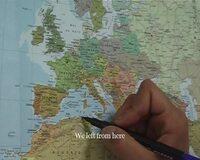
UntitledA series of videos that trace the routes of several African immigrants through Italy to France where they have ultimately joined the French Foreign Legion. An emigrant draws on a map of the world the route he has followed. In this way, creates a bridge between the feelings of an emigrant being tossed back and forth and the superficiality of a geographical map.
Untitled“My grandmother was born in what is now Burkina Faso, as a result of an encounter between a French soldier and a young African woman. The discovery of the unique fate of the mixed-race minority to which she belongs, as they were separated from their mothers, abandoned by their fathers and finally confined in orphanages, returns me to my own mixed-race identity.” Available online until November 19th 2021.
UntitledWhen independence came, the owners of the big boats decided to sell up, so many small-scale fishermen soon found themselves out of work. Their wives decided to pool their gold rings and sell them to buy new boats.
An unemployed Algerian worker leaves Paris hitchhiking. He soon reaches Brittany and, captivated by the beauty of the wild gorse, ends up setting himself up as a gorse vendor. But because of parking issues with his small cart, he has a rough run‑in with a policeman, who reacts violently and overturns the cart, scattering the flowers. The intervention of some factory workers, and the warm solidarity they show him, saves him from despair. A poetic and humorous fable in which an Algerian immigrant travels across Brittany in search of work. He finds a cart and begins selling gorse in a small town. When a policeman violently knocks over his cart, the flowers spill onto the ground. At the factory gates, the women workers, as a sign of solidarity, pick them up one by one and buy them from him. The film won the Anti‑Racist Film Award granted by the Amicale of Immigrant Workers’ Associations in Europe in 1970.